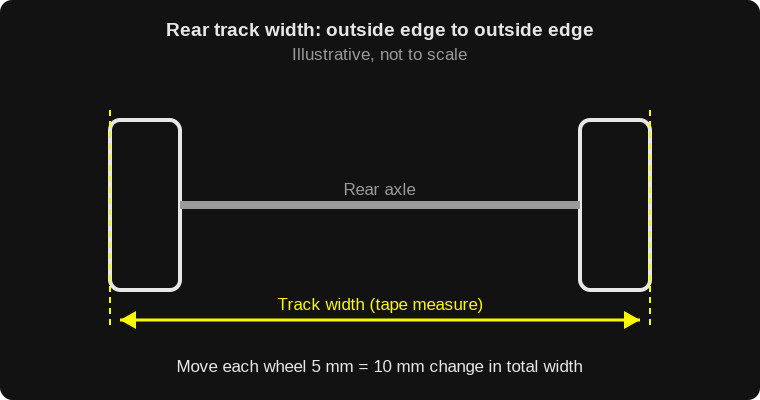
Rear track width is the distance between the outside edges of the two rear tyres, and changing it changes how easily the inside rear wheel lifts and how stiff the rear axle behaves. Moving it by a few millimetres can change the balance noticeably, but published advice disagrees on which direction adds grip, so the sensible approach is small steps, one change at a time, and a logged baseline to compare against.
What does rear track width actually change?
It changes leverage and axle flex, which together decide how much inside rear wheel lift you get in a corner. Flow Racers explains that widening lowers the effective centre of gravity and exposes more axle, so the inside wheel lifts later and the rear feels softer. Narrowing does the opposite: quicker, more responsive turn-in, with more risk of the kart becoming snappy or the rear hopping.
Wider or narrower: which gives more rear grip?
Honestly, it depends on who you ask, and that is useful to know before you start. Flow Racers summarises it as wider giving more rear grip and understeer, narrower giving more oversteer. Kart Class says nearly the reverse: wider improves braking stability but can reduce mid-corner and exit grip, while narrower increases rear grip and rotation but can feel twitchy.
Part of this is vocabulary. “Grip” can mean traction on exit, stability under braking or how much the rear rotates, and a change can help one while hurting another. Some guides, including the Flow Racers article itself, are also internally inconsistent about direction. So do not carry a rule from one article to the track. Treat each direction as a hypothesis, and let your lap times and your driver’s description decide.
| Change | Commonly reported upside | Commonly reported risk |
|---|---|---|
| Wider rear | Stability under braking, less hopping on bumpy tracks | Less rotation, possible loss of exit grip (Kart Class) |
| Narrower rear | Quicker turn-in and rotation | Twitchy rear, hopping, sudden traction loss |
Both guides say conditions matter. Flow Racers suggests narrower in cold, slippery conditions and wider in hot, sticky ones, and Kart Class treats rear width as a race-day lever. Our wet weather setup post covers why wet and dry tests should be logged separately.
How big a change should you make?
Make the smallest change you can measure. Flow Racers recommends 10 mm at a time (5 mm per wheel), and Kart Class suggests 2-3 mm per side for cadets. Move both wheels by the same amount unless you are deliberately correcting an imbalance.
Check your class rules before moving far in either direction. One source quotes a 1400 mm maximum, but limits depend on the class and regulations, so check the rulebook yourself.
What should you check before touching rear width?
Check the cheaper, more obvious things first so you do not chase the wrong cause. Tyre pressures and front end settings interact with rear width, and Flow Racers recommends changing front and rear track width one at a time for that reason. Our tyre pressures guide, front end setup post and axle stiffness post cover the neighbouring adjustments. Axle stiffness in particular overlaps with rear width, because both change rear flex.
Also check the basics: hub bolts tight, tyres on the same pressure side to side, and the measurement taken on a flat surface.
How do you test a rear width change fairly?
Run a baseline, change only the rear width, then compare like for like.
- Measure and record the current width, tyre set, pressures, and track and air temperature.
- Run a consistent stint and note the best lap, the average of your best few laps and the driver’s comments.
- Move both wheels the same small amount. Re-measure, tighten, recheck pressures.
- Repeat the same stint.
- Keep the change only if both the times and the feel improve. If the difference is smaller than your normal lap-to-lap spread, call it neutral.
Slow-corner exit and turn-in are where a width change should show up in your telemetry, so compare those parts of the lap and not only the lap time. Our karting data analysis post shows how to read that.
How do you log rear width changes in KartSetups?
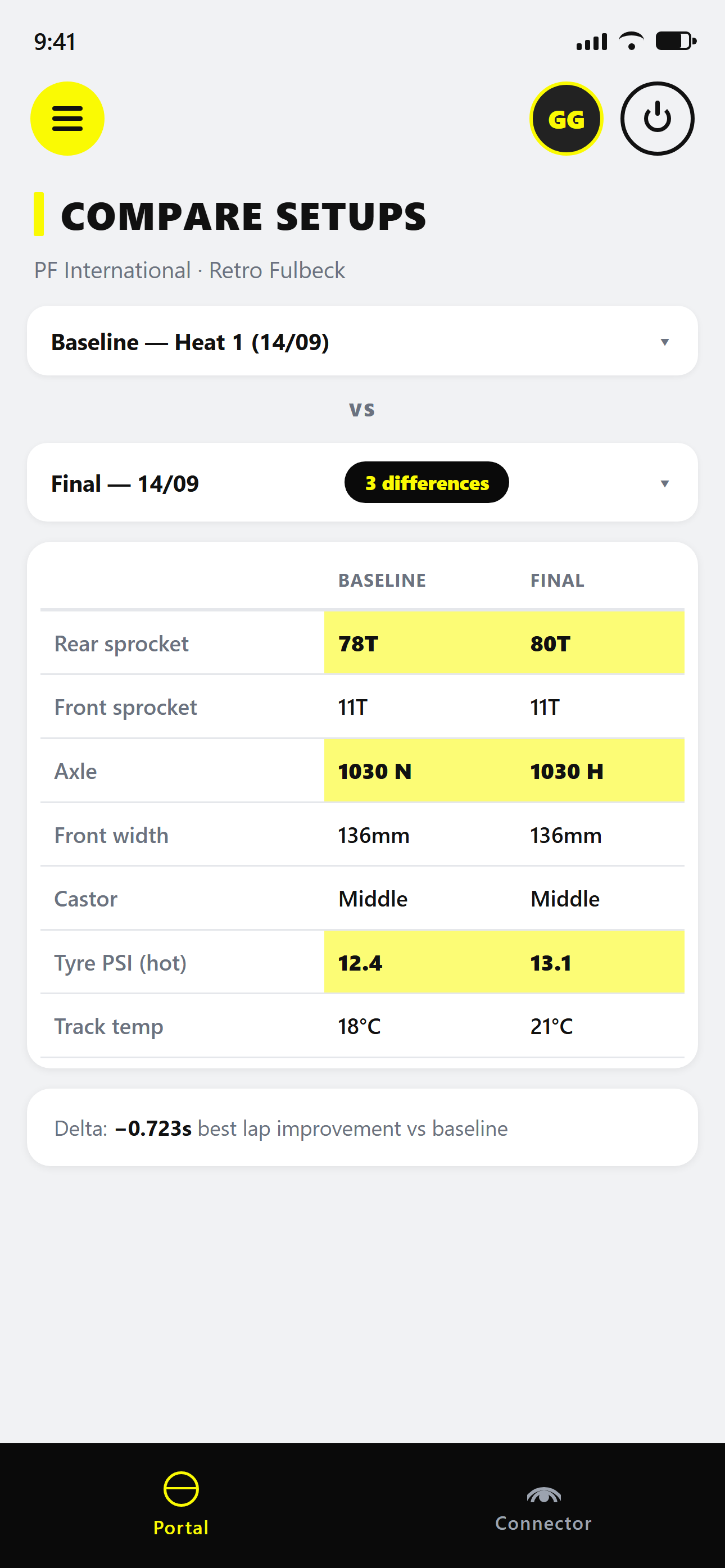
Record the measured width in the setup for every session, and use a baseline so the change is the only difference. KartSetups’ Compare Setups view lines up two setups and highlights what changed, with the best lap delta underneath, so you can see whether the width was the only thing that moved.
If you keep paper notes, our setup sheet guide lists the fields worth recording, and track widths belong on it.