Kart tyre pressure is set cold but works hot, so the useful number is the pressure the tyre reaches after a run, not the one you pumped in. Measure cold before you go out, measure hot the moment the kart stops, and use the difference to choose the next cold pressure. A few tenths of a bar either way can change how the kart turns in and how long the tyres last.
The catch is that gauges, tyres and tracks all differ, so a pressure copied from another team is only a guess. What transfers is the method, and a log that shows what your own tyres did.
What is the difference between cold and hot kart tyre pressure?
Cold pressure is what you set before the tyres have run, hot pressure is what you read straight after a session. Heat from the track and the tyre flexing raises the pressure, so hot is always higher.
Two published examples show the scale. One guide that works in bar shows 0.60 bar cold rising to about 0.85 to 0.90 bar on track. A US guide quotes 2 to 4 psi of growth on a typical sprint circuit and 2 to 5 psi over a run, with more on hot days, abrasive tracks or aggressive driving, and little growth in cold or wet conditions. For conversion, 1 psi is about 0.069 bar, so 4 psi is roughly 0.28 bar. Those two sources agree more than they appear to.
These are vendor figures, not controlled tests. Use them to sanity-check a reading, not as targets.
What pressure should a kart tyre run?
Start from the tyre maker’s and your class’s guidance, then find the hot pressure your tyre likes. There is no universal answer, and anyone quoting one without naming the tyre and conditions is guessing.
One guide gives dry cold starting ranges of 0.60 to 0.70 bar for Mini, 0.45 to 0.55 bar for Junior and Senior, and 0.45 to 0.52 bar for KZ and DD2. A US guide gives a hot range of about 14 to 18 psi for many hard-compound tyres, adding that you should test to find what yours prefers. Treat each as a frame to test inside, not a rule.
In general terms, cooler or low-grip tracks need a higher cold start so the tyre can come up to temperature, and hot, high-grip days need a lower one to avoid overheating. Too high loses grip and too low can stop the tyre working properly or, at extremes, risk the tyre moving on the rim.
How do you set cold pressure from a hot target?
Pick the hot pressure you want, then work backwards using the growth you measured last time. The routine below is the one most guides converge on.
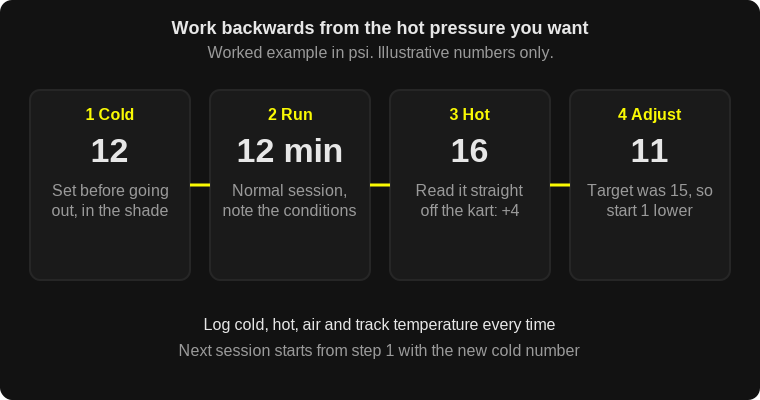
- Set the same cold pressure on every tyre, out of direct sunlight, with a gauge you trust.
- Run a normal session.
- Read hot pressures as soon as the kart stops, because the tyres lose heat every second. Do it before the driver gets out if you can.
- Compare with your hot target and change the next cold start by the difference.
A worked example from one guide: 12 psi cold reading 16 psi hot is 4 psi of growth. If the day warms up and you want the same hot pressure, lower the cold start slightly. If the kart felt loose or greasy late in the run and you came off at 18 psi, drop the next cold start by about 2 psi. If you finish above target, some drivers bleed down to target while hot, which also lowers the cold number you will need next time.
What do the pressures tell you about balance?
Tyre pressure is a balance tool as well as a grip one: the corner you change affects how that end of the kart behaves. Changing all four evenly shifts overall grip, while changing one end changes the balance between front and rear. One forum guide says the goal is even hot pressures all the way round, which is worth checking before you chase balance with anything else.
Be careful with direction rules. They depend on the tyre, the track, the chassis and the driver, so write down what you changed and what the kart did rather than trusting a rule that someone posted. If the driver says the kart is understeering, change one thing by a small amount and see.
Why does logging both readings matter?
Because the cold number alone is meaningless, and you cannot compare sessions without it. Two setups with the same cold pressure on different days can run very different hot pressures.
For each session, record:
- Cold pressures per tyre, and the gauge used
- Hot pressures per tyre, read straight after the session
- Air and track temperature, and whether it was damp
- Tyre set, and how many laps it has done
- What the driver said about grip, and the lap times
In KartSetups, hot and cold tyre pressures sit in the session setup next to the kart, engine and tyre set, and weather fills itself in. Compare Setups then highlights what differed between two sessions, including pressures, so you can see whether a lap-time change came with a pressure change. Our guide to the kart setup sheet shows the fields worth keeping in one place.
Does tyre age change the pressures?
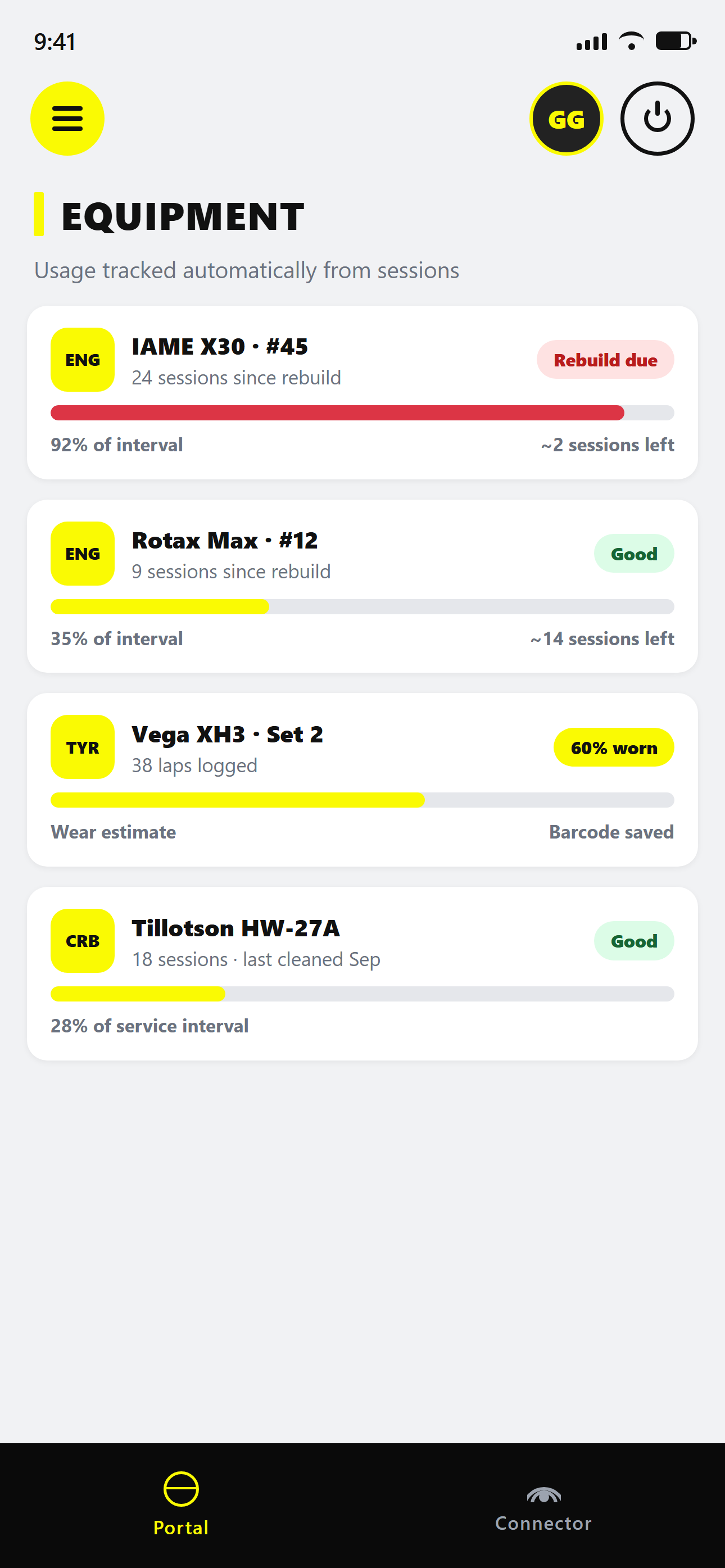
It can, so keep the set and its mileage in the log. A fresh set and a worn set do not behave the same, and pressure that suited the first heat on new tyres may not suit the same tyres later in the day. KartSetups logs laps against each tyre set automatically from your sessions, which means you can see the age of the tyres next to the pressures that worked. For the wider habit of testing one change at a time, see karting data analysis.
Sources
- Drake Kart: kart tyre pressure guide for the cold ranges by class, the 0.60 to 0.85 to 0.90 bar example and the 0.05 bar sensitivity.
- Swift Karting: hot vs cold growth for the 2 to 5 psi growth, the measure-immediately advice and the worked adjustments.