A good kart setup sheet records three things for every session: the context (track, tyres, weather), the setup values as they were on the kart, and what happened afterwards. Copy the previous sheet, mark only the values you changed, and fill in the outcome straight after the session. That turns a pile of numbers into a history you can actually learn from.
Most downloadable sheets are a list of boxes for chassis numbers. That’s the easy part. The sheets that earn their place also capture why you made a change and what it did.
What are the three blocks of a useful setup sheet?
Split the sheet into context, setup values and outcome. Context and outcome are the blocks people skip, and they’re the ones that make the numbers meaningful later.
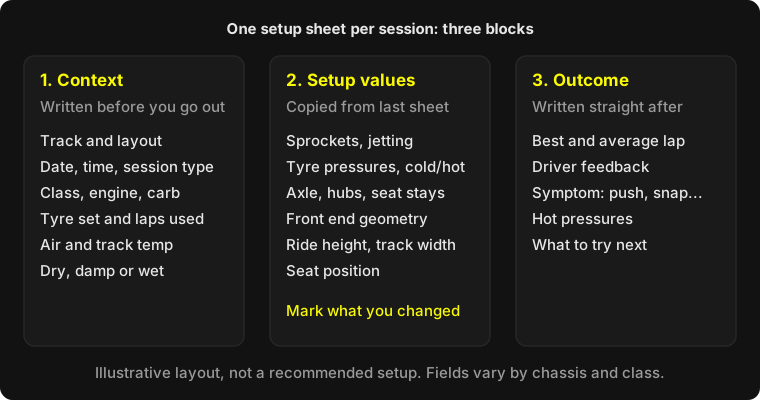
1. Context. Track and layout, date and time, session type (practice, qualifying, heat, final), class, engine and carb, tyre set and laps on it, air and track temperature, and whether it’s dry, damp or wet. Without this, a lap time has no meaning. “Sprocket up one tooth, 31.4” says nothing if you don’t know it was the first session on a green track.
2. Setup values. The things you can adjust: sprockets, jetting, cold and hot tyre pressures, axle, hubs and seat stays, front end geometry (caster, camber, toe, track width), ride height and seat position. Leave a spare line for anything specific to your chassis. Manufacturer setup guides differ on what to list and what the ranges are, so follow yours rather than a generic figure.
3. Outcome. Best lap and the average of your best few, hot pressures after the run, and the driver’s words: understeer on entry, snap oversteer on exit, rear lifting in slow corners. Finish with one line: what you’ll try next.
How do you set a baseline on the sheet?
Pick a starting point you trust, run it, and label that sheet as the baseline. Reasonable starting points are your chassis manufacturer’s recommended setup or your own last known-good sheet for the same track and class.
Everything afterwards is measured against it. If you wander several changes away and the kart feels wrong, you can go back to the baseline sheet instead of guessing. This is also why you should record sessions where nothing changed: they confirm the baseline still behaves the way it did.
How do you record a change so it’s useful later?
Write the change, the reason and the result on three connected lines. “Rear sprocket down a tooth, because revs were hitting the end of the straight early, result: …” is a note you can use. “Changed gearing” isn’t.
A habit that works well on paper or in an app:
- Copy the previous sheet to a new one before the session.
- Edit only the values you intend to change and mark them (a ring or an asterisk).
- Limit yourself to one or two changes per run. If you change four things, you can’t say which one worked.
- After the session, write the symptom and the outcome while it’s fresh.
Pressures deserve particular care. Tyre suppliers and chassis makers publish their own recommendations, and community advice is often framed as small steps, such as half a psi at a time, with colder weather generally calling for higher starting pressures and hotter weather for lower. Treat those as a direction to test and log both cold and hot readings, rather than a number to copy.
What goes wrong with paper sheets?
Paper fails in three ways: you lose it, you can’t read it, and you can’t compare it. The first two are annoying. The third is the real cost.
Say you want to know what you ran at the same circuit last October when it was cold. On paper that means digging through a folder or a box. In a spreadsheet you can search, but you’ll end up with a tab per weekend and no easy way to see differences. Forum threads on building the “ultimate” setup sheet keep returning to the same compromise: lots of check boxes to save writing time, but still enough space for notes.
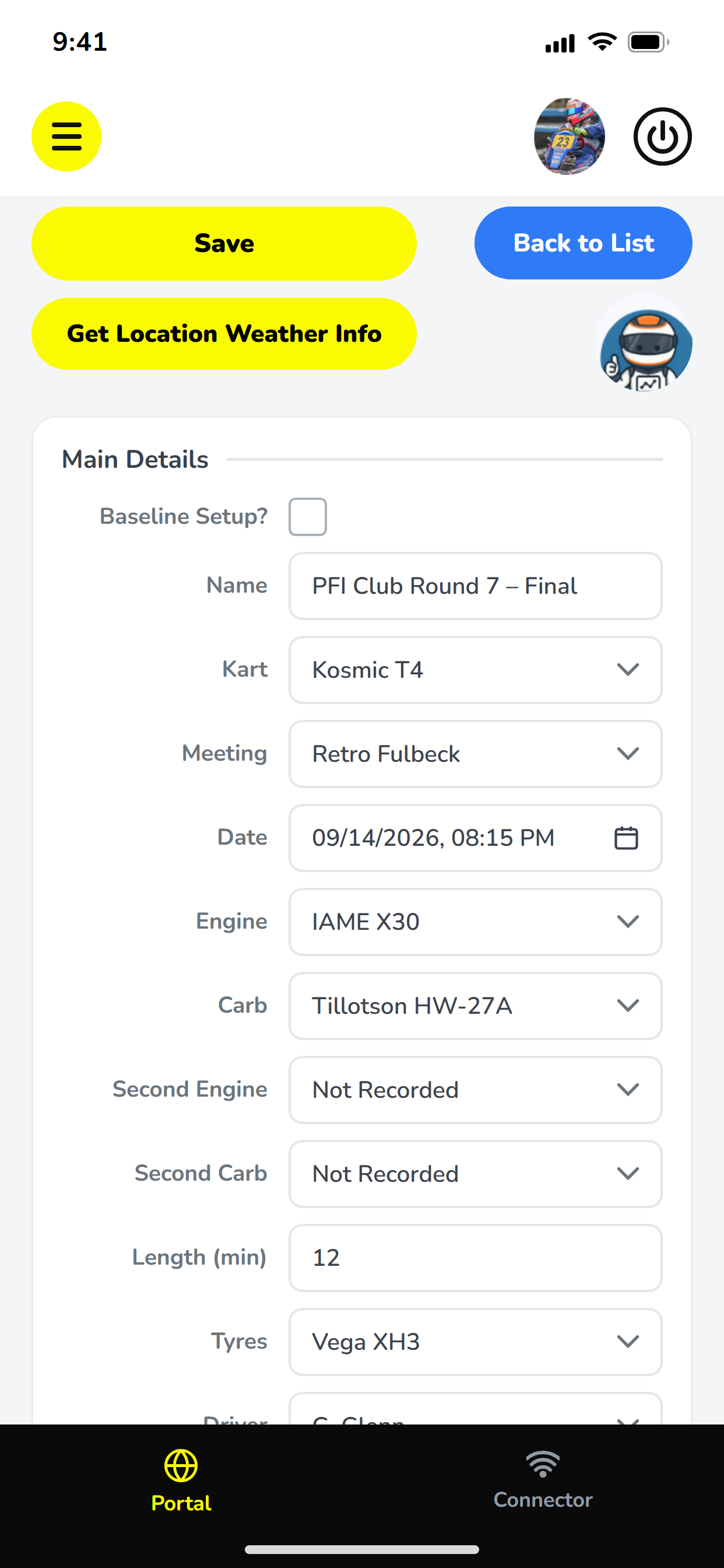
If you’d rather not run your own spreadsheet, KartSetups is built around this same structure. Each session stores its setup, you can tick one as the baseline, and weather can be filled in from the location. Compare Setups then puts two sessions side by side with the differences highlighted, and the sessions list shows which changes were made between sessions next to the lap time delta. The principle is the same as paper: one sheet per session, and a clear record of what changed.
How does a setup sheet connect to your data?
Your logger data tells you what the kart did; the sheet tells you why it might have. When you read a speed trace and see a higher minimum speed but a slower exit, the sheet is where you look for the change that caused it. Our post on karting data analysis covers how to compare laps once you have both.
Log the same channels and the same conditions every time, and a season of sheets becomes a track guide: what worked at each circuit, in which weather, on which tyres.
A quick checklist before you close the sheet
- Is the context complete: track, session type, tyres, weather?
- Are changed values marked?
- Did you record cold and hot pressures?
- Is there a driver comment in plain words?
- Is there a next step written down?
If you can answer yes to all five, the sheet will still make sense in six months. If you want to see how the tool side works, there’s a 7-day free trial on the pricing page.