A softer kart axle flexes more and a harder one flexes less, and the usual advice is to use a softer axle in cold, wet or low-grip conditions and a harder one when the track is hot and grippy. Medium is the normal baseline. How big the effect is on your kart is debated, so treat any axle change as an experiment: change nothing else, compare against a logged baseline, and keep it only if the laps and the driver agree.
What does a kart axle do for handling?
The rear axle is part of the chassis flex, and its stiffness mainly changes how readily the inside rear wheel lifts in a corner. Flow Racers links a harder axle with the inside wheel lifting more easily and a more oversteery kart, while a softer axle keeps more tyre on the ground, leaning towards understeer but with better traction out of slow corners. The same article stresses that the axle does not create grip itself. Grip comes from the tyres.
Stiffness is set by the steel’s processing and wall thickness, not simply by diameter, and brands label their ranges differently. So “hard” on one axle is not the same number as “hard” on another. Always record the exact type.
When do guides suggest a harder or softer axle?
Most guides land on the same rule of thumb, and it is the same one worth testing first.
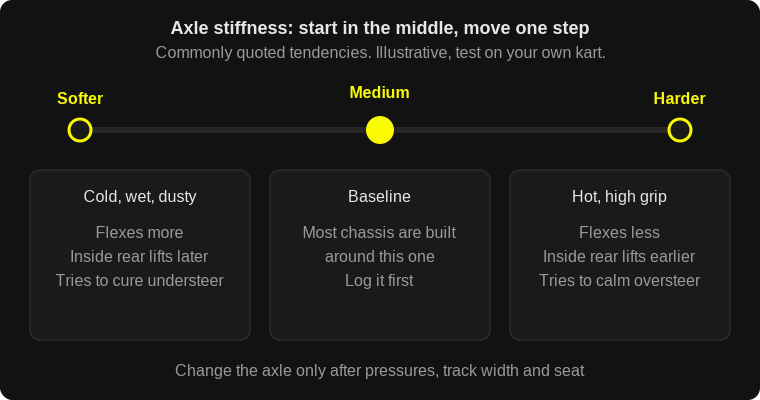
Kart Class describes soft axles as suiting cool, wet, dusty or freshly resurfaced tracks, where they add responsiveness. Hard axles suit hot, high-grip or rubbered-in tracks, keeping the rear planted and letting the driver get on the power earlier. Medium is what many chassis are designed around, and it is where many racers start a weekend.
Be aware that sources are not fully consistent on the mechanism. Some describe soft axles as helping the inside rear lift, others the opposite. That is a good reason to rely on your own logs.
Does axle stiffness really make a difference?
Sometimes, but plenty of karters doubt it. Flow Racers notes that many drivers found no measurable difference between stiffness levels and that placebo is likely, since a driver told what an axle should do often feels it. Results also vary by driver style and circuit.
That does not make the axle useless. It means the evidence has to come from you. A change you cannot see in lap times or repeatable driver feedback is not worth chasing.
What should you try before changing the axle?
Sort out the cheaper, faster adjustments first. Flow Racers suggests checking tyre pressures, suspension geometry, seat height and track width before reaching for a different axle, and changing one thing at a time. Our tyre pressures guide and front end setup post cover two of those.
If you do want a smaller step than a full change, Kart Class mentions shortening a standard 1030 mm medium axle to about 1000 mm to add flex. Check that is allowed for your chassis and class before you touch it.
How do you test an axle change fairly?
Run the same baseline twice, then swap only the axle and run it again. Aim for the same tyre set age, similar track temperature, same pressures and the same stint length, and write down the driver’s description of the balance each time.
- Record the baseline: axle type, axle length, track width, pressures, tyre set, track and air temperature.
- Run a consistent stint and log best lap and the average of your best few laps.
- Change only the axle. Keep everything else, including pressures.
- Run the same stint and compare.
- If the result is within normal lap-to-lap variation, call it neutral and go back to what is simplest.
Check the telemetry as well as lap time where you can: slow-corner exit speed is where a traction change should show up. Our data analysis post walks through reading that.
How do you log axle changes in KartSetups?
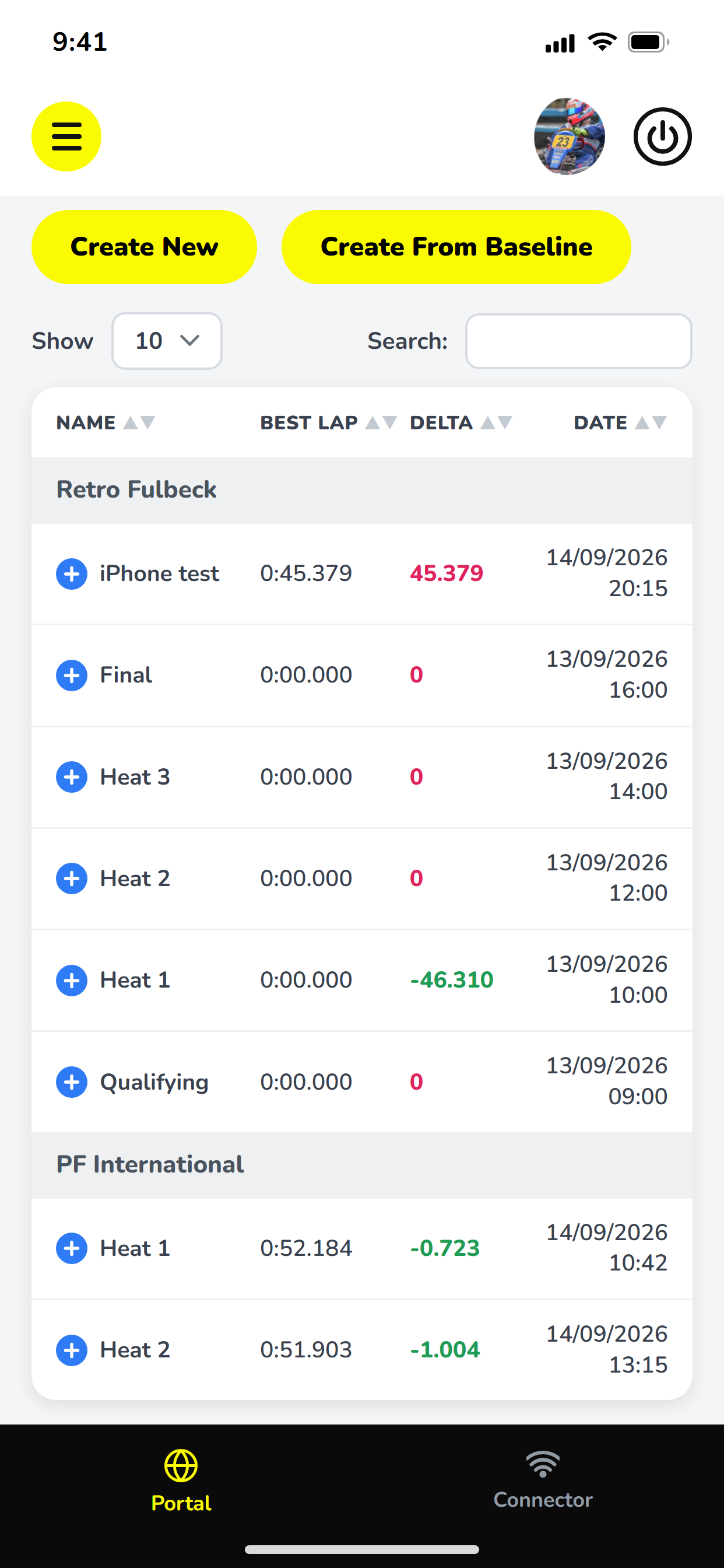
Record the axle type, length and rigidity in the setup for each session so the change appears as a difference, not a memory. KartSetups has axle length and rigidity fields, with OTK axle types in the rigidity dropdown, as listed in the release notes. The sessions list has a Create From Baseline button, so you start from the previous setup and change only the axle.
If you keep paper notes instead, our setup sheet guide lists the fields worth including, axle among them.