On a kart, the front end is tuned with four main levers: caster, camber, toe and front track width. Broadly, more caster adds front grip but heavier steering, toe-out sharpens turn-in at the cost of tyre wear, camber tunes how much tyre touches the track, and a wider front track helps the inside rear wheel lift. Change one at a time, in small steps, and write down what the kart did.
Published advice on all of this is a mixture of experience and opinion, and sources disagree in places. Treat what follows as directions to test against your own logged baseline, not rules.
What does caster do on a kart?
Caster is the backward lean of the kingpin, and adding it generally gives more front grip and heavier steering. Kart360 describes more caster shifting weight to the front and effectively shortening the wheelbase, which suits wet or slippery tracks. Too much on a grippy track can overpower the rear and give understeer.
Less caster eases the steering and reduces rolling resistance, which can help drivers who find the steering heavy or lower-powered classes. Go too far and the front loses bite. Kart Class suggests more caster for cold or wet tracks and less for very hot conditions. Our wet weather setup post covers the wet case in more detail.
What does toe-out do?
Toe-out points the front edges of the front tyres slightly apart, which improves corner entry but makes the kart twitchier and increases tyre wear. Kart Class quotes a typical setting of about 1 to 2 mm per side, suiting tight, technical tracks.
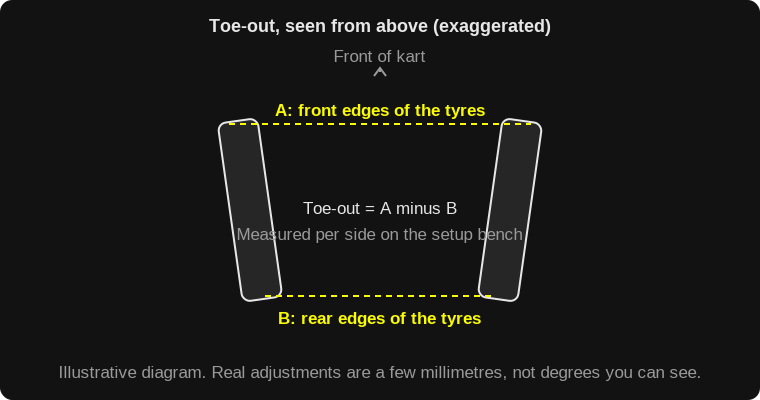
One practical trap: toe is set with the kart on the stand and no driver. With the driver aboard the figure shifts towards zero. Whatever your method, write down how you measured so the number means the same thing next week.
How does camber change the handling?
Camber tilts the tyre in or out at the top, and it mainly controls how much of the tyre is flat on the track. Kart Class suggests more negative camber for stability in fast, flowing corners and less for tight, slow ones. For understeer it advises reducing negative camber for more contact patch, and for oversteer adding negative camber to calm the initial steering response, with the risk of tipping into understeer.
Be aware that sources use the sign convention differently, and not all agree on which direction adds grip. Before adjusting, check your own kart’s adjustment method and measure the starting point. Camber also changes tyre wear: Kart Class notes positive camber wears the outer edges faster and negative the inner edge, and Kart360 warns that excessive positive camber can overheat the fronts and cause feathering.
What does front track width do?
A wider front track tends to lift the inside rear wheel more, which helps the kart rotate, while a narrower one makes it more nimble but less responsive in corners, according to Kart Class. It suggests fine-tuning with 5 mm spacer steps and notes that small changes can have big effects.
Which way should you go for understeer or oversteer?
Use this as a starting list of things to try, not a diagnosis. The first column describes what the kart is doing, and the right-hand side is what guides most often suggest.
| Kart is doing | Things often tried first |
|---|---|
| Understeer (front pushes wide) | Less negative camber, a little more toe-out, narrower front track |
| Oversteer (rear steps out) | More negative camber, a little less toe-out, check the rear and tyre pressures too |
| Steering too heavy | A touch less caster |
| Not enough front grip in cold or wet | More caster |
Several of these interact, and the answer on the day also depends on tyre age, pressure and track grip. Our tyre pressures guide is worth checking before blaming the geometry. A tyre that has not come in yet can look exactly like a front end problem.
How do you log front end changes properly?
Record the front end figures in the same fields every session, so that a change shows up as a difference rather than a memory. Include caster position, camber, toe (and how you measured it), front track width, tyre set and pressures, and the track conditions.
In KartSetups the setup entries sit alongside the session, and Compare Setups puts a baseline and a final setup side by side with the differences highlighted and the best-lap delta underneath. In this example only the sprocket, axle and pressure changed, so the lap gain can be tied to those and not to the front end.
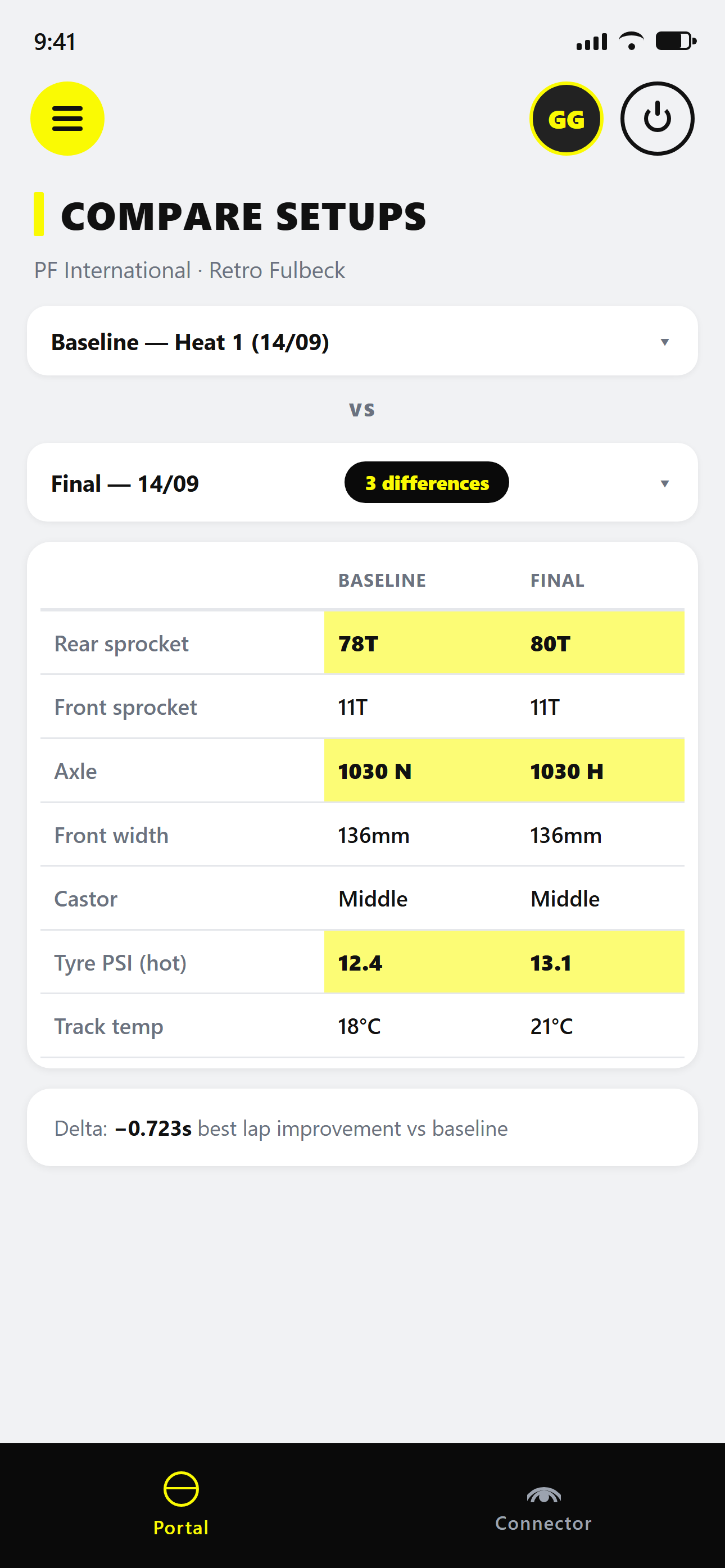
If you are building your own sheet, our kart setup sheet guide lists the front end fields worth capturing.
How do you know a front end change worked?
Compare like with like: same tyre age, similar track temperature and the same stint length against your previous baseline. Look at the lap time, but also at the driver’s description. If a change makes the kart feel better but is not quicker, note that as well. The next conditions may suit it.
Avoid stacking changes. If you adjust caster and toe in the same session and the kart improves, you do not know which one did it, and you will not know which to reverse when it does not.