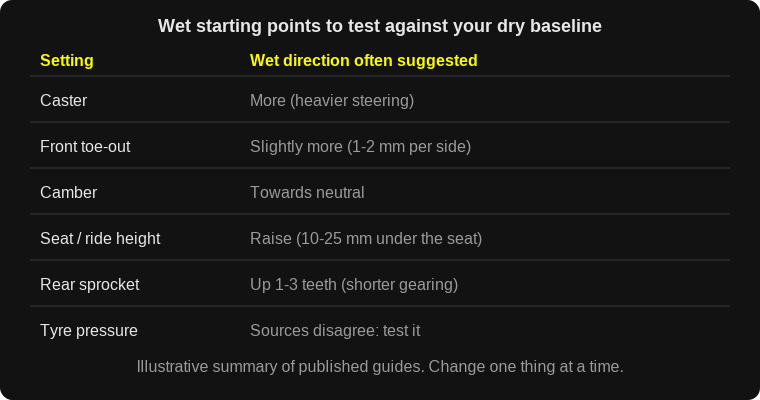
For a wet kart, the usual direction is more grip and a softer, more forgiving kart: more caster, a little more front toe-out, camber nearer neutral, a higher seat, slightly shorter gearing, and tyre pressure that you test rather than assume. Treat all of those as starting points to try against your dry baseline, one at a time.
The reason to be careful is that wet advice is full of disagreement and shifting conditions. A change that helps on a drying track can hurt on a flooded one, so the real skill is recording what you tried and what the track was doing.
What should you change first for a wet kart setup?
Start with the changes that add front-end grip and rotation, because lack of grip is the main problem in the rain. Most coaching guides converge on caster, toe and camber first, then seat height and gearing.
How do caster, toe and camber change in the wet?
More caster and a touch more toe-out are the usual moves, with camber nearer neutral. Kart Class suggests more caster so the inside rear wheel lifts and the kart rotates rather than pushing on, at the cost of heavier steering. It also suggests adding about 1 to 2 mm of toe-out per side from your dry setting, and warns that too much adds drag on the straights.
On camber, the same site’s dry versus wet comparison describes slight negative in the dry and neutral or slightly positive in the wet, to keep the tyre flatter on the surface. Check your own kart’s adjustment range first, and make small changes.
Does seat position and ride height matter in the rain?
Yes: raising the seat or the whole kart adds grip, and seat position changes where the kart slides. The same comparison suggests 10 to 25 mm of padding or a seat insert under the driver in the wet, and a softer chassis set-up for more flex.
Seat position is more subjective. A forward seat usually gives more turn-in but can make the kart slippery on exit, while a rearward seat tends to help mid-corner and exit grip in slippery conditions. If the kart is already nervous, moving the seat back is one thing to test rather than a fix.
What gearing works best in the wet?
Slightly shorter gearing, usually, so the engine recovers quickly out of slow corners and wheelspin is easier to manage. One guide suggests going up roughly 1 to 3 rear teeth. Another points out that Rotax drivers often change the front sprocket instead, where one front tooth is worth around 6 to 7 rear teeth.
That advice has limits. A driver without good throttle control can lose the rear faster with shorter gearing, and a lightly wet track may still be best on a drier set-up. Our kart gearing guide covers how to work out the ratio you are really changing.
What about tyre pressure in the wet?
This is where the sources disagree, so the honest answer is to test it. Some say slightly higher pressure helps in cold rain because the tyre warms faster and resists aquaplaning. Others suggest 0.1 to 0.2 bar lower than dry for a larger contact patch. Both camps agree that hot pressure after a run is what to trust.
Our kart tyre pressures post has a simple cold-to-hot logging routine that works just as well in the wet. If you are not sure which direction suits your tyre, run one session each way and compare the lap times and the hot readings.
How do you log a wet session so it is useful next time?
Record the setup, the weather and the track state together, because a wet session is only comparable to another wet session in similar conditions. Wet tracks also change within a session, so note whether the surface was soaked, damp or drying.
Useful fields to capture:
- Caster, toe and camber settings, plus seat position and height
- Front and rear sprocket, and any change from your dry baseline
- Tyre set, cold and hot pressures
- Air temperature, rain intensity and track state
- Driver comments on front grip, rotation and exit traction
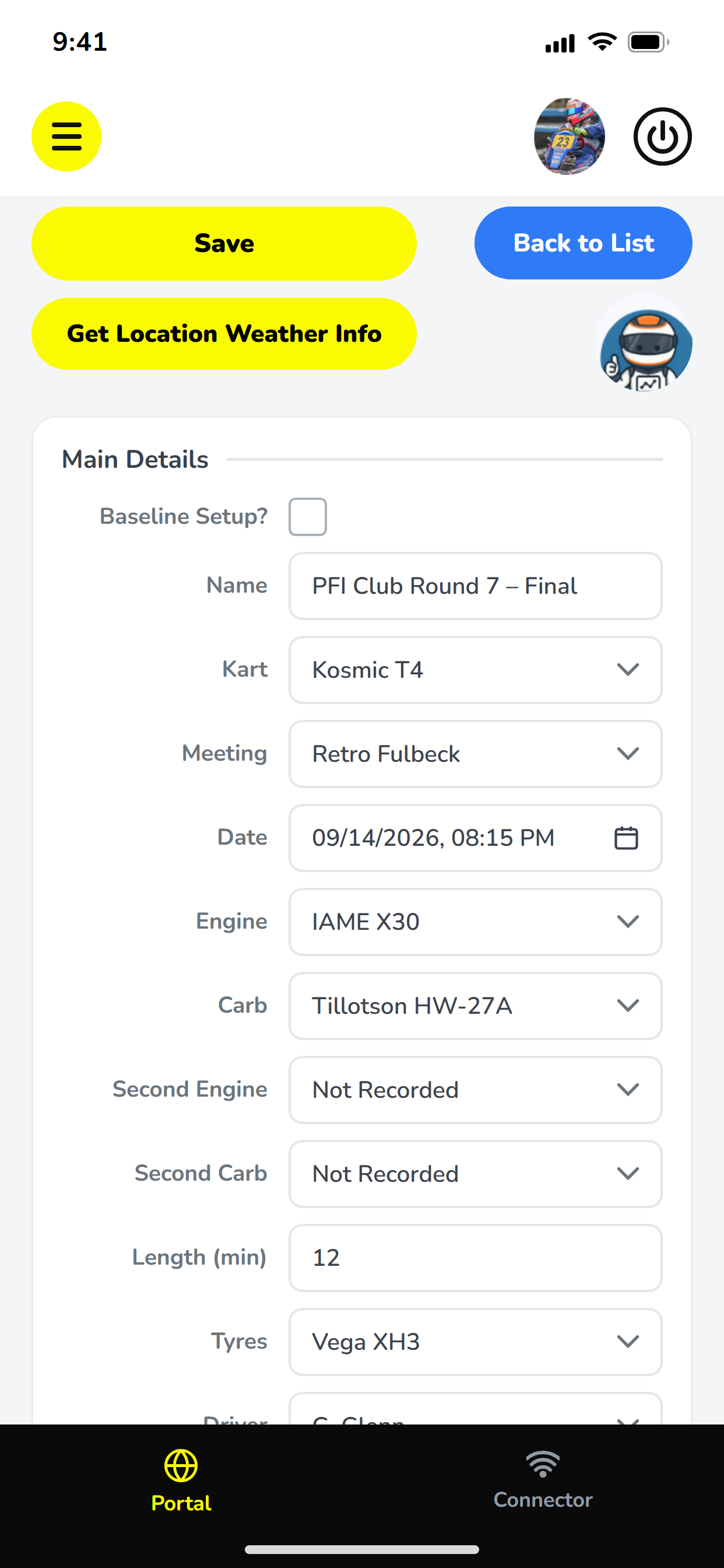
In KartSetups, the session setup form has a button to pull in the weather for the session location, so the conditions sit next to the kart, engine, carb and tyres. Compare Setups then shows what differed from your last wet session, so you can see which change went with the lap-time change.
If you want a template for what to capture, see the kart setup sheet guide.
How do you tell whether a wet change helped?
Change one thing, run the same stint length, and compare against the previous wet baseline with the conditions noted. If the track was drying or the rain eased, a quicker lap proves little.
Remember the coaching view that wet performance is mostly the driver. A smoother entry and gentler throttle often beat a setup change, so log the driver’s comments alongside the numbers and don’t credit the kart for what was driving.