Kart gearing is the rear sprocket teeth divided by the engine sprocket teeth. More rear teeth means shorter gearing: stronger acceleration and higher revs at any given speed, but a lower top speed. The right ratio is the one that lets the engine reach its limit only briefly at the end of your longest straight and keeps the revs up in the slowest corners.
That balance moves with the track, the tyres and the weather, so no tooth count is correct everywhere. What you can do is read your own data and change one tooth at a time.
How do you work out kart gearing?
Divide the rear sprocket by the front: ratio = rear teeth ÷ engine teeth. A 78-tooth rear on an 11-tooth front is 78 ÷ 11 = 7.09:1.
The useful part is what a tooth does. Revs at a given speed scale directly with the ratio. Using an 11-tooth front and a 0.84 m rolling circumference as a worked example (arithmetic, not a measured result):
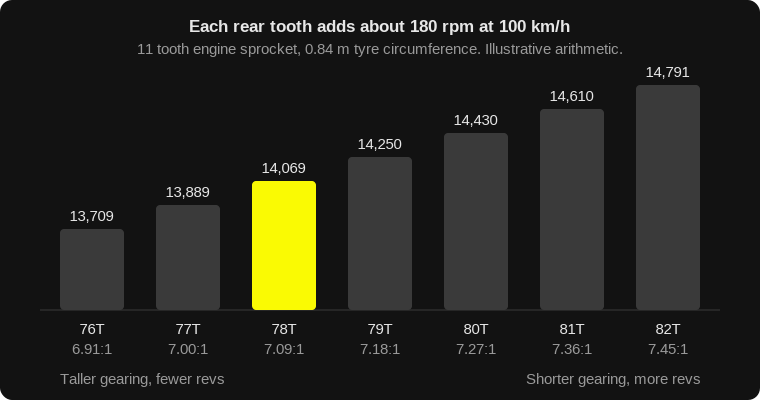
So one tooth is roughly a 1.3% change. That is why teeth are the standard unit of adjustment, and why two teeth at once can hide whether the change was good or bad. Your own tyre circumference will shift the absolute rpm figures slightly, but the step size stays about the same.
How do you tell whether you are too short or too tall?
Look at two points on the lap: the end of the longest straight, and the slowest corner. Both are visible on an RPM trace from an AIM, Alfano or Starlane logger.
- End of the longest straight. If the engine hits the limiter well before the braking point and sits there, the gearing is too short. If it only just touches the limiter, or never gets there, it may be too tall. Some coaches look for the engine just touching the limiter for a second or two before you brake.
- Slowest corner. The minimum revs tell you whether the engine is still in its working range. One coaching source gives a rule of thumb that revs below about 7,000 rpm at the low point mean the rear sprocket is too small, while another frames roughly 7,000 to 8,000 rpm as a floor for Mini and OKJ engines. These are rough frames for those classes, not rules, and a poor line can drop the floor just as easily as the wrong sprocket.
Do not trust a single lap. Take several clean laps from the same session and use the typical value, then compare corner exit speed as well as the revs. If the floor is low because of the line you drove, fix the driving before you change teeth.
Rev limits differ by engine. One source quotes about 16,000 to 16,200 rpm for the IAME X30 and 14,200 to 14,400 rpm for Rotax, but check your own engine’s documentation and class rules for the figure that applies to you.
What does gearing change in different conditions?
Grip and engine state change how many revs you can use, so gearing that was right in the morning can be wrong in the afternoon.
| Condition | Usual direction | Why |
|---|---|---|
| Wet or low grip | Shorter (bigger rear) | Less traction, more time pulling out of corners |
| Rubbered-in, high grip | Taller (smaller rear) | Corner speeds rise, revs drop less, the straights get longer |
| Qualifying | Often a touch shorter | One lap, so sharper acceleration can pay |
| Longer race | Test both | Tyre wear and engine heat change how it feels |
These are directions to test, not fixed answers. The coaching advice on wet running for most classes is a couple of rear sprocket sizes bigger, but how far you go should be set by what the trace shows. Qualifying versus race gearing is a particular judgement call: a shorter ratio can help a single flying lap, while a race often wants the kart to stay clear of the limiter.
How do you test a gearing change properly?
Change the rear sprocket by one tooth, change nothing else, and compare the same laps and the same corners before and after. Here is a routine that works:
- Record your baseline session with the sprocket pair, tyre set and conditions.
- Change one tooth. Tick it off on the setup sheet so it is clear what moved. Our post on the kart setup sheet shows a layout for this.
- Run a few clean laps. Do not compare a flying lap to an out-lap.
- Compare the RPM at the end of the straight and the minimum RPM in the slowest corner, plus the lap time delta.
- If the change helped, keep it and log why. If it did not, go back to the baseline and try the other direction.
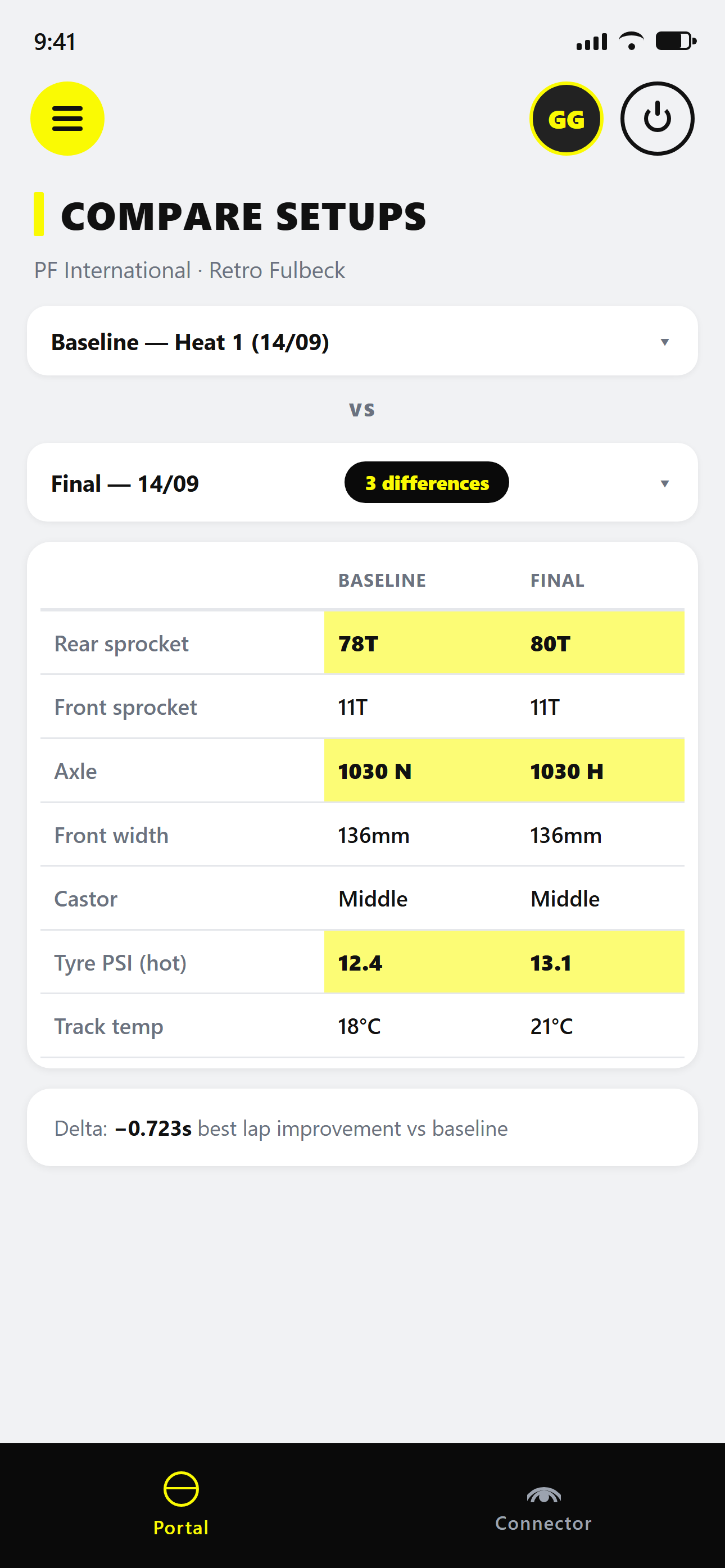
Note that this screen also shows an axle and tyre pressure change between the sessions. That is exactly the situation to avoid when you are testing gearing: if more than one thing changes, the lap time cannot tell you which one did the work.
In KartSetups, front and rear sprockets are separate fields and the ratio is calculated for you, and Compare Setups puts two sessions side by side with the changes highlighted. The Kart Engineer chat also has a knowledge base that includes UK track gearing tables, which can give you a sensible starting point before you head out. Read more about how the logger side fits together in our guide to karting data analysis.
Can a different front and rear combination give the same ratio?
Yes, on paper. 11 and 78 gives 7.09:1, and 12 and 85 gives 7.08:1. Equal ratios from different tooth counts produce the same revs at the same speed, although some drivers prefer one combination for chain and sprocket wear or for how it feels. The practical reason to adjust the rear is resolution: a tooth on the rear is a finer step than a tooth on the front.
What should you log every time you change gearing?
Write down the sprocket pair, the ratio, the conditions and the result, so you can reuse it. At a minimum, log:
- Front and rear sprocket, and the ratio
- Track, layout and session type
- Air and track temperature, and whether the surface was damp
- RPM at the end of the longest straight and in the slowest corner
- Best lap and the driver’s comments on acceleration and top end
After a season, that record is your own gearing table for each circuit. If you want to try that approach, there is a 7-day free trial on the pricing page.
Sources
- Kart Class: finding the right sprocket size for the rev-limiter figures, the low-rpm rule of thumb and the wet-weather suggestion.
- PURPL: kart gear ratio for the RPM-trace method and the one-tooth step size.