Moving a kart seat forward shifts weight onto the front tyres, which usually adds turn-in and front grip, while moving it back shifts weight to the rear for more traction and stability. Raising the seat is commonly linked with more grip and wet conditions. These are starting points to test, not rules, so move one thing in small steps and compare the laps against a logged baseline.
What does seat position actually change on a kart?
The seat is the heaviest adjustable item on the kart, so where it sits changes the front-to-rear weight split. Kart Class says a seat further forward gives more front-end grip and responsiveness, and further back gives rear stability and traction under acceleration. Its warnings matter as much as its advice: too far forward can mean a lot of oversteer on entry, and too far back a lot of understeer on entry, even though exit traction improves.
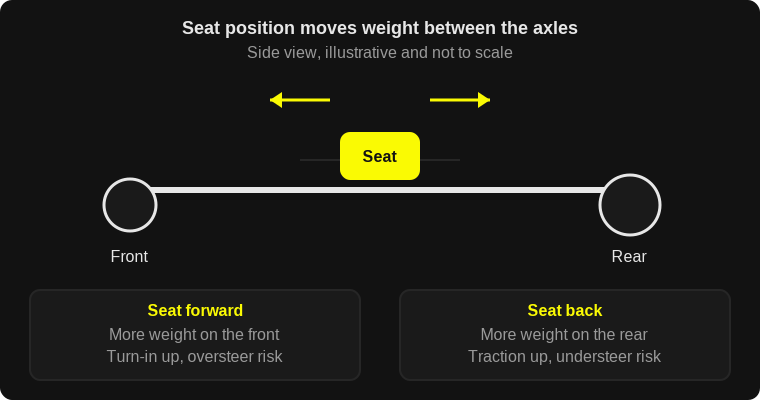
Be aware that this is not settled. Comet Kart Sales points out that the answer depends on class: in a TaG class moving back adds rear weight and grip, while in a class like Yamaha less rear weight may help free the rear. It also warns that going too far back can stop the kart loading the inside rear tyre through corners. Some forum posters go further and argue the simple “back means more rear grip” rule is wrong. That is a good reason to trust your own logs.
Should the seat go forward or back for more grip?
The common guidance is that the grippier the track or tyre, the further forward the seat should sit, and low-grip conditions suit a seat slightly further back. Comet says grippier tracks and tyres generally call for a more forward seat. Work from the symptom, and remember these are tendencies, not guarantees:
| Symptom | Direction guides suggest trying |
|---|---|
| Understeer on entry, front tyres sliding | Seat forward a little |
| Rear steps out on entry, kart feels nervous | Seat back a little |
| Poor drive off slow corners | Seat back a little |
Kart Class advises moving the seat forward again if, having gone back, understeer becomes severe or the front tyres start graining, so there is a limit in each direction.
How big a step should you make?
Small. Comet suggests about 10 mm at a time when you are trying to free the kart up, and other guides suggest very small moves. Loosen the mounting bolts, move the seat, re-measure from a fixed point such as a chassis rail or axle, and tighten. Then re-check that the pedals and steering wheel still suit the driver. Moving the seat changes reach, and a driver who is stretching or cramped will be slower regardless of the balance.
What does seat height do?
A higher seat is generally described as adding grip and suiting smaller drivers and the wet, and a lower seat as suiting taller drivers, high-grip tyres and a kart that bounces. Kart Class links a higher seat with a higher centre of gravity and better weight transfer. Comet gives a practical limit for lower seats: it says not to go more than 8 mm below the frame rails and calls 5 mm a safe amount, and raises the seat by stacking aluminium sprockets underneath. Our wet weather setup post covers why seat height is part of a rain baseline.
Check the class regulations before changing seat height or position. Minimum seat heights and mounting rules exist in many classes and we can’t tell you which apply to yours, so read the current rules from your organiser.
What about weight distribution and corner weights?
A set of scales is the only way to see what a move really did. One karting forum discussion quotes a typical target of roughly 43 to 44 percent front and 56 to 57 percent rear, and about 50/50 side to side, measured with the driver in the seat. Treat that as a rough guide. Your chassis maker’s guide and your class matter more than any generic figure.
How do you test a seat move fairly?
Treat it like any other single-variable test. Our data analysis post goes into reading the result, and the basic routine is:
- Record the baseline: seat position, height, tyre pressures, track and air temperature, tyre set.
- Run a consistent stint and note the best lap and the average of your best few laps.
- Change only the seat, and measure how far you moved it.
- Run the same stint again, with the same pressures.
- Ask the driver what changed on entry, mid-corner and exit, then check whether the laps agree.
Do the seat move before you reach for bigger changes. Our axle stiffness post and front end setup post both suggest the cheaper adjustments come first.
How do you log a seat change?
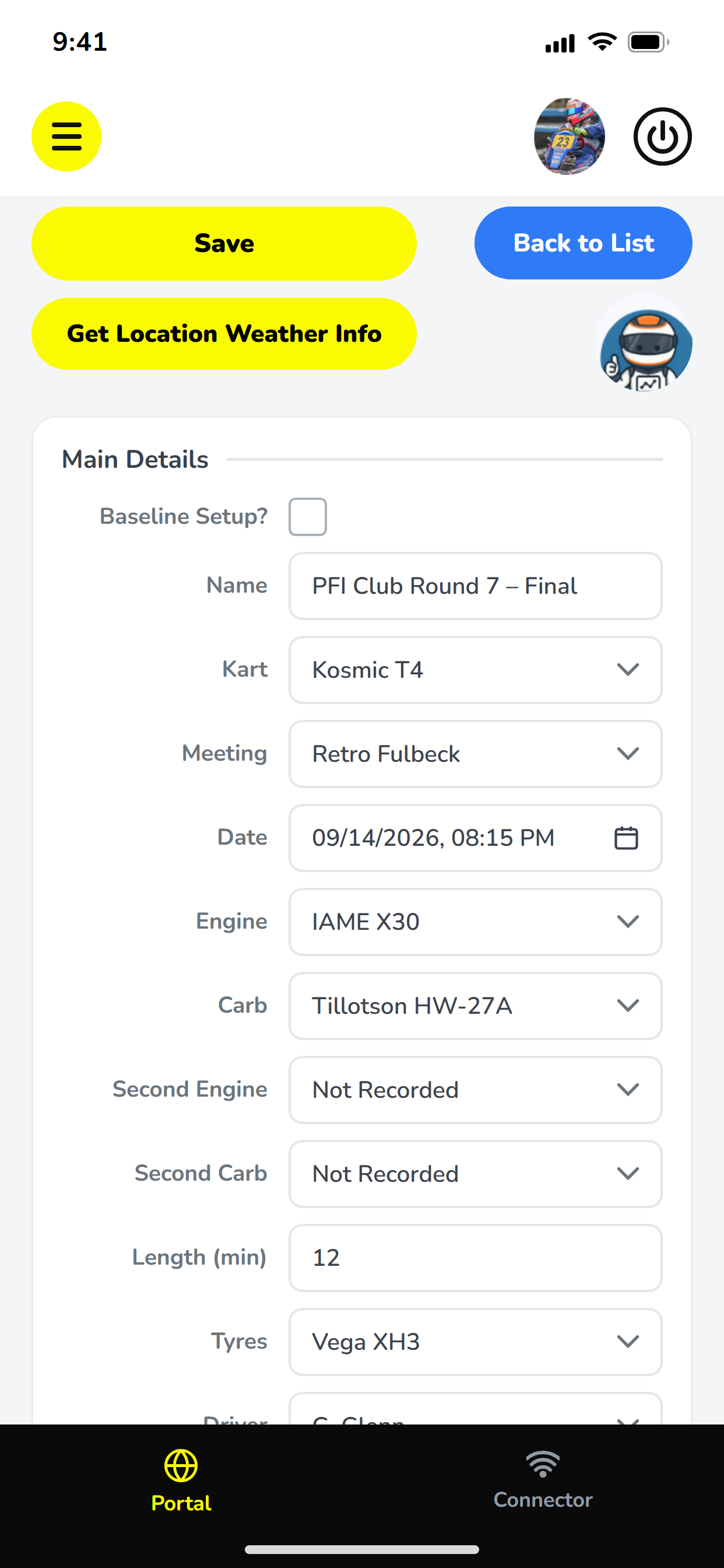
Write the seat position as a measurement, not a feeling, so you can get back to it. In KartSetups, tick Baseline Setup on the setup you trust, then use Compare Setups to put the new session beside it and see the differences highlighted. That only shows what you have recorded, so put the seat measurement in the setup alongside everything else. See the release notes for the fields currently available.
If you use paper, our setup sheet guide lists what to include, and seat position is one of them.