A good kart race day checklist has three parts: a packing list for the van and toolkit, a short safety check you repeat before every session, and a post-race list for logging what happened. Splitting them stops the safety check getting lost among spare sprockets, and means the logging actually happens.
Nothing on these lists is clever. They work because you do the same things in the same order when you are tired, rushed and the grid is forming. The examples below are a starting point to adapt to your own kart, class and series.
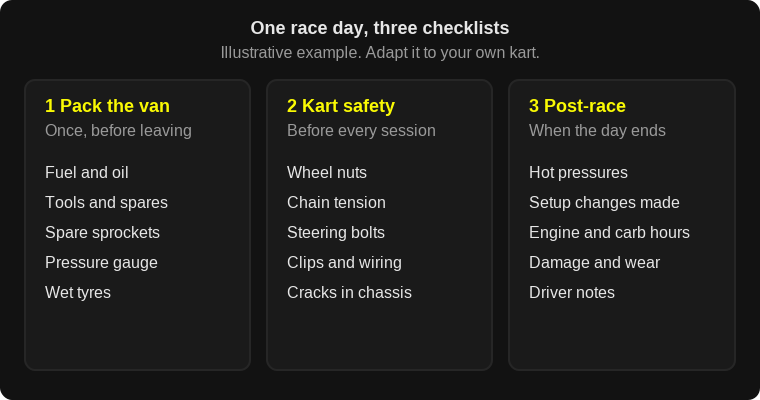
What should you pack for a kart race day?
Pack by where things live: van, toolkit and spares. That makes gaps obvious, because you check one area at a time rather than scanning a long flat list.
Common items across the guides and forums we read:
- Fuel and oil, with a jug that you can measure from. Mixing at the track is where mistakes happen, so write the ratio on the jug.
- Tools and spares: the tools you actually use, plus spare chain links, clips, a spare plug and any consumables for your engine. One guide notes some tracks have specialist tools on site, so check before packing everything.
- Gearing spares: sprockets either side of your normal choice. Our kart gearing guide explains how to choose them.
- Tyre gear: a pressure gauge you trust, and wet tyres if the forecast is uncertain. See kart tyre pressures for the cold and hot routine.
- Personal kit: helmet, suit, gloves, balaclava. Sanctioning bodies and tracks set their own helmet standards, so check your series regulations rather than assuming.
- Comfort: water, food, a cover if the weather is unpredictable, a charger or battery pack, and the awning and generator if you use them.
- Paperwork: licence, entry confirmation and any scrutineering forms your event asks for.
What should you check on the kart before every session?
Check the parts that cause a retirement or a safety problem if they fail, in the same order every time. Vibration loosens hardware, so the common agreement across guides is wheel nuts, hub and axle bolts, chain tension and alignment, steering column hardware and engine mounts.
A sensible short list:
- Wheel nuts and hub hardware, especially after a tyre change.
- Chain: tension, condition and sprocket alignment. A stretched chain needs replacing, not just tightening.
- Steering column and tie rod hardware, and the clips on them.
- Safety wiring and clips present and secure on anything that has one.
- Brake pedal feel and pad condition.
- A look over the chassis for cracks, particularly around welds and mounts.
A kartpulse forum thread makes the honest point that checking every nut and bolt before every session is unrealistic. Its answer is a short list you really do every time, plus a full check on a schedule. That is a better rule than a long list nobody finishes.
Your series scrutineers may check specific items, so follow their requirements on top of this.
How do you stop forgetting things?
Use a saved list you tick off, not memory, and do it in the same place each time. Time pressure is what makes people skip steps, so make the list quick enough that skipping it feels slower than doing it.
Two habits help. First, build the list from your own mistakes: every time something is forgotten, add it. Second, split the lists by moment, as in the diagram, so the packing list is finished the night before and the safety check is the only one in your head at the grid.
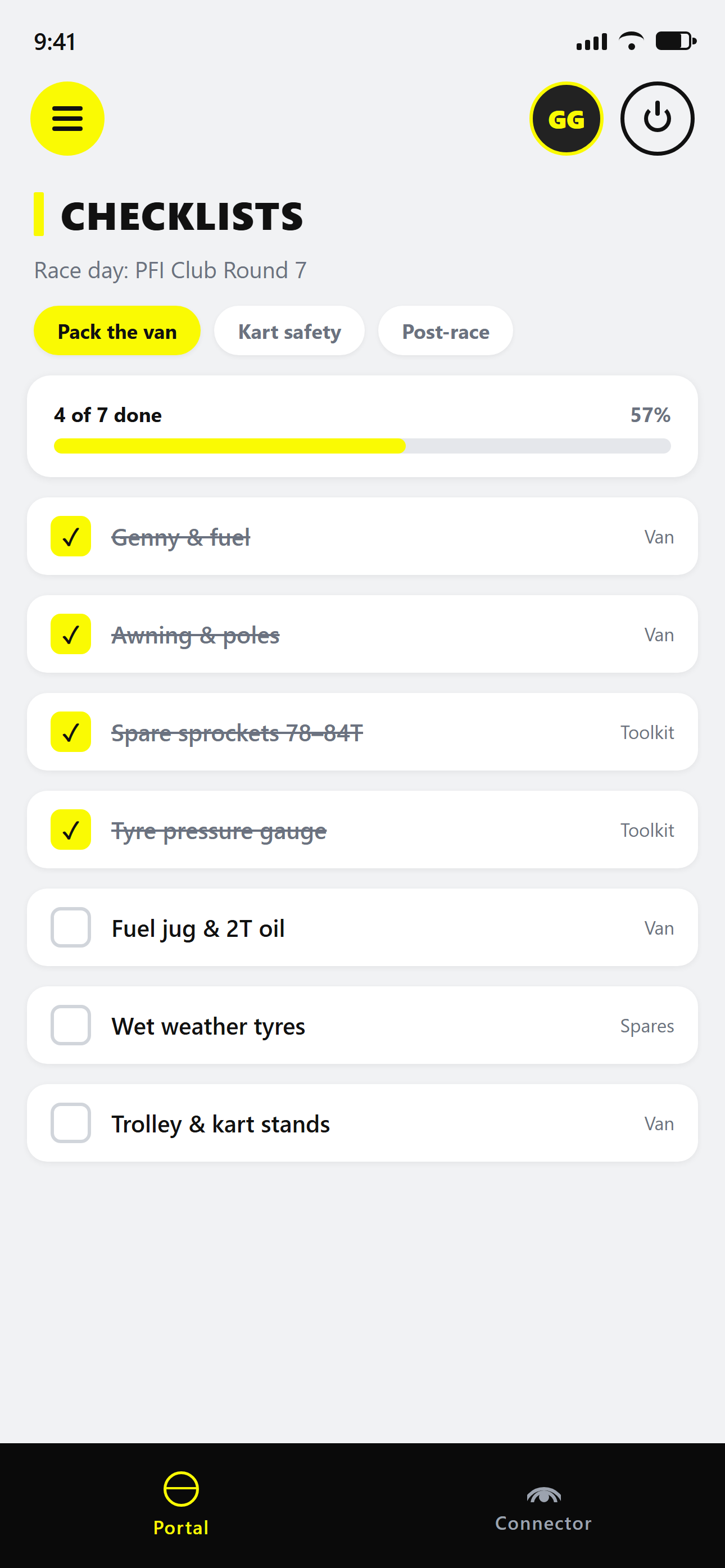
If you use KartSetups, checklists are tied to a race day and you can ask the Kart Engineer to create or update one for you, which is handy for copying last meeting’s list and adding the new track’s items. Details are in the release notes.
What should you log after a race day?
Log it at the track, before packing up, while the numbers and the driver’s comments are fresh. A good post-race list is short and feeds straight into your setup notes:
- Hot tyre pressures per corner, read straight after the session.
- Setup changes you made between sessions, and the order you made them in.
- Driver feedback in plain words, and best lap per session.
- Engine and carb running time, so rebuilds are scheduled by use, not guesswork.
- Damage, wear and anything to fix before the next meeting.
This is where a race day turns into data you can use. Our guide to karting data analysis shows how to check whether a change worked, and the kart setup sheet lists the setup fields worth keeping. KartSetups logs laps against engines, carbs and tyre sets from your sessions and flags rebuilds when they are due, so the post-race list becomes quick confirmation instead of a notebook exercise.
Sources
- Kartpulse: what needs to be checked on a kart and how often for the short-list-every-time approach.
- Kartpulse: what to bring to a practice day or race day for common packing items.