A new or freshly rebuilt kart engine should be run in under load, on a rich mixture, with the revs stepped up in stages rather than held low or taken straight to the limiter. The exact schedule, oil ratio and rev limits are set by the engine maker, so use theirs first. This post covers the common ground between published schedules and what to log so you can check the engine afterwards.
Why does a new kart engine need running in?
New piston rings, cylinder walls and bearings are not perfectly matched at first. Running in lets them wear into each other, under a good supply of oil, without overheating. Two-stroke kart engines get their lubrication from the oil in the fuel, so a lean mixture is the main danger during this period.
I could not find any single source that settles every detail. Engine builders and forum drivers disagree on how hard to push, how much to use the choke and whether heat cycles help. What follows reports what each source says and marks where they differ.
What does a published running-in schedule look like?
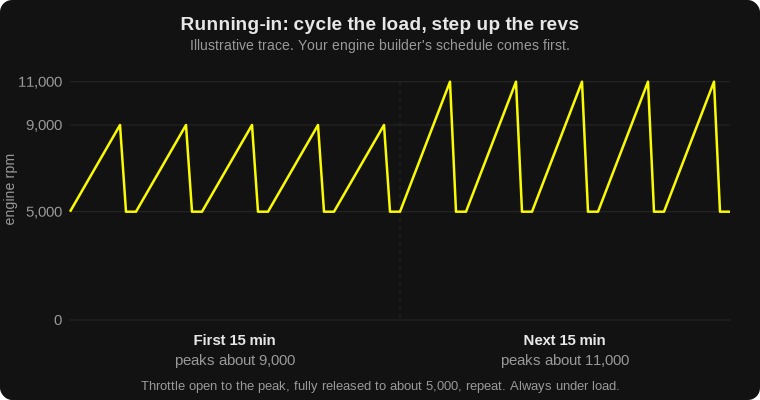
The clearest manufacturer example I found is the Rotax 125 MAX DD2 manual. It asks for two stages with the kart on track:
- 15 minutes with continuously changing load and speed, up to 9,000 rpm
- a further 15 minutes with load and speed changes up to 11,000 rpm
- throttle fully open to the target rpm, then fully released until the revs fall to around 5,000, then repeat
- never run without load
- a slightly oil-richer first fill of 1:33, then the specified 1:50 afterwards, using fully synthetic two-stroke oil
That is for the DD2, a gearbox engine. A TAG or direct-drive engine will have different numbers. The shape is what carries over: cycle the load, step up the revs, stay under load.
How do other karters do it?
A KartPulse forum thread on engine break-in shows how much opinion varies:
- One driver quotes PRD’s instruction sheet: at least 45 minutes in 15-minute periods, starting with short bursts at half to three-quarter throttle with a rev cap, then moving to full throttle in short bursts, capped at 11,000 rpm.
- Another, who works with X30s and Leopards, advises stepping up in rev bands over several laps and keeping the high-speed needle rich.
- A third prefers flat-out running with a rising rev target, arguing that lifting off starves the cylinder of oil and that part throttle takes longer to bed in. Others in the thread warn that over-choking can damage reeds.
These are forum posts, not engine builder advice, and some are for 100cc engines. They do agree on the main themes: don’t let the engine run lean, don’t overheat it, and build up in stages. Where they disagree, the manual or your engine tuner wins.
Why run it rich?
The DD2 manual asks for an oil-richer first fill, and other sources say to jet on the rich side while the engine beds in, because a lean engine runs hotter with less lubrication. You can trim it back after the engine is free, and the DD2 manual’s own tuning section is the place to find its jetting. Our carburettor jetting post covers how to read the plug and how weather changes the mixture.
Does load matter more than heat?
Load matters. High Performance Academy, writing about car engines, argues that rings seat under combustion pressure and that long light-load running is a poor way to do it. That is a four-stroke source, so don’t treat it as proof for a two-stroke kart engine, but it matches the DD2 manual’s instruction to keep a load on the engine and the forum view that gentle part-throttle running is slow to bed in. Long periods of idling are not what any of these sources recommend.
What should you check afterwards?
When the running-in is done, go through a short list:
- Spark plug: it should look rich and dark, not pale. Pale means lean, so go richer before you go anywhere near the limiter.
- Fixings, chain and leaks: things can work loose on a new engine, so re-check engine mounts, sprocket, chain alignment and tension. See chain tension.
- Jetting: re-jet once the engine is free, as air temperature will have moved from the day you started.
- Temperature: watch water temperature during the stages and stop if it climbs. Water temperature explains what to look for.
What should you log for a run-in?
A run-in is easy to forget, and it matters later when an engine feels flat or tight. Record:
- The engine number and what was replaced (piston, rings, cylinder, bearings, whole top end)
- The date, track or location and weather
- The stages you ran, with times and the rev limit for each
- Oil mix and fuel, jetting and plug condition at the end
- Any problems, plus how the engine felt at its first race
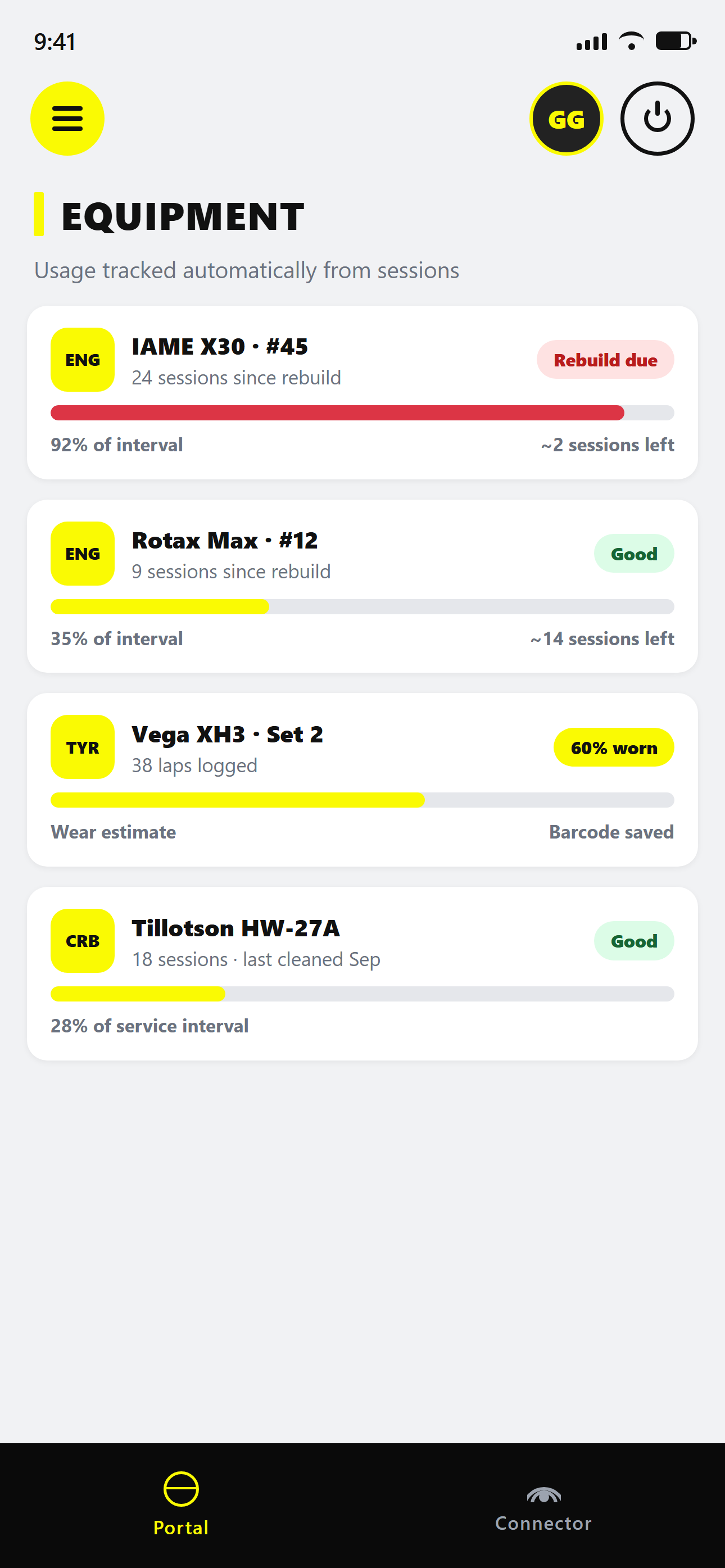
In KartSetups the engine is picked on each session, and the Equipment page shows sessions since the last rebuild against the interval you set, with Rebuild due warnings. You can add notes to a rebuild log, and completing a linked job card can log the rebuild and reset maintenance hours. These features are listed in the release notes. When an engine’s results fade you can look back and see how it was run in and how many sessions it has done. If you don’t yet set intervals, engine rebuild intervals is a good place to start.
What mistakes should you avoid?
- Running it unloaded or on a stand with no load. The Rotax manual says never without load.
- Running it lean to “free it up”. This risks a seizure, and the damage can be done in seconds.
- Taking it straight to the limiter. The manufacturer schedules step up in stages.
- Skipping the post-run check. A loose chain or a pale plug at the first race is a bad way to find out.
- Not recording it. Without notes, a run-in is a guess when you come to diagnose a slow engine.
If you want an engine’s history, rebuilds and sessions in one place, see pricing and features and try KartSetups free.