Kart carburettor jetting is the job of matching the fuel mixture to the air your engine is breathing. Cold, dry, low-altitude air is dense and wants more fuel, while warm, humid or high-altitude air is thinner and wants less. Start from your engine builder’s baseline, change one thing at a time, err slightly rich, and write down the conditions with every change so next time you are not starting from memory.
Why does the weather change your jetting?
The weather changes how much oxygen each gulp of air contains, and the jets only meter the fuel. Denser air means more oxygen for the same fuel, so the mixture runs leaner. Thinner air does the opposite. Temperature, humidity and altitude or barometric pressure are the three drivers, and guides such as the KartClass carb jetting guide list all three.
Temperature is the easiest to put numbers on. For dry air at constant pressure, density follows the ideal gas law, so it is proportional to one divided by the absolute temperature. The chart below is calculated that way, relative to 15°C.
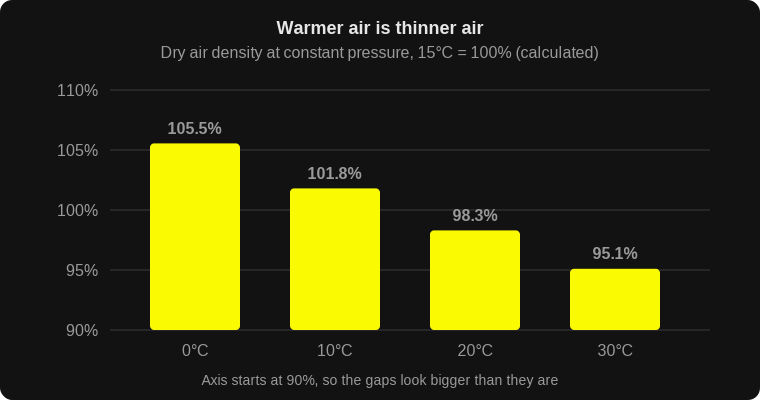
A swing of 10°C is therefore worth about 3 to 4% in air density. That is small, but engine tuners notice it, and humidity and pressure move the figure further. We can’t tell you how many jet sizes that equals for your engine, because that depends on the carburettor, and we won’t guess.
What are the signs of a rich or lean mixture?
Lean mixtures hurt more than rich ones, so the signs worth learning are the lean ones. A lean kart typically gets away poorly, responds late to the throttle and runs hot. Too lean on a two-stroke can overheat and seize, because the engine is starved of the fuel that carries its lubrication. A rich kart tends to feel flat or bogged and sound “too rich” on the exhaust note, though bogging can be either condition, so don’t rely on that sign alone.
The widely repeated rule is to err on the side of slightly rich. A touch rich costs a little top end, while a touch lean can cost an engine. Richer mixtures also tend to favour low-rpm power and leaner ones high-rpm power, which is why some people jet differently for tight tracks and fast ones, as the KartClass guide notes.
How do you read a spark plug for jetting?
Read the plug as a clue about the whole run, not a measurement. The colour depends on every lap since the plug went in, including slow laps and the cool-down, and fuel and oil type also change it. A KartPulse forum thread on carb jetting adds two more checks: the piston crown should be clean near the transfers and dark elsewhere, and carbon under the crown suggests the engine is running too hot.
Two cautions. Many sources suggest running at least 20 minutes first so a fresh plug has coloured properly. And some people cut the engine at full throttle to capture the full-load mixture, which should be done only if your class and track rules allow it and you can do it safely. Always combine the plug with how the kart pulls and how the engine sounds.
How should you change the jetting?
Change one thing at a time, in small steps, and always from a known baseline. A practical sequence for a race weekend:
- Record a baseline: the jet, needle and any screw settings your carb has, plus the temperature, humidity and pressure.
- Check the carburettor is clean and in good order first. The same KartClass guide advises cleaning it after running in the rain, since dirt restricts fuel flow.
- Make one change, run a comparable stint and note how it pulls on the straight and out of slow corners.
- Check plug and engine condition after the run.
- Only then make the next change.
Anything much beyond that depends on the carburettor. Fixed-jet carbs leave you few options, while those with adjustable low-speed and high-speed circuits give you more. Follow your engine builder’s guidance and your series rules rather than a forum jet number. Our wet weather post covers how conditions change what you log.
How do you log jetting so it is repeatable?
Log the carb setting together with the weather, and the next time similar conditions show up you have an answer. Jetting without the conditions is just a number. Jetting with the conditions is a repeatable result.
In KartSetups the session setup form has engine and carb fields, and the Get Location Weather Info button pulls weather in automatically, using Open-Meteo, rather than you copying it from a phone. That means the setup sits next to the temperature it was made for, and Compare Setups lets you line sessions up and see what changed. Carbs also log their own usage, so a carb rebuild is flagged when it is due. The release notes list what is currently supported.
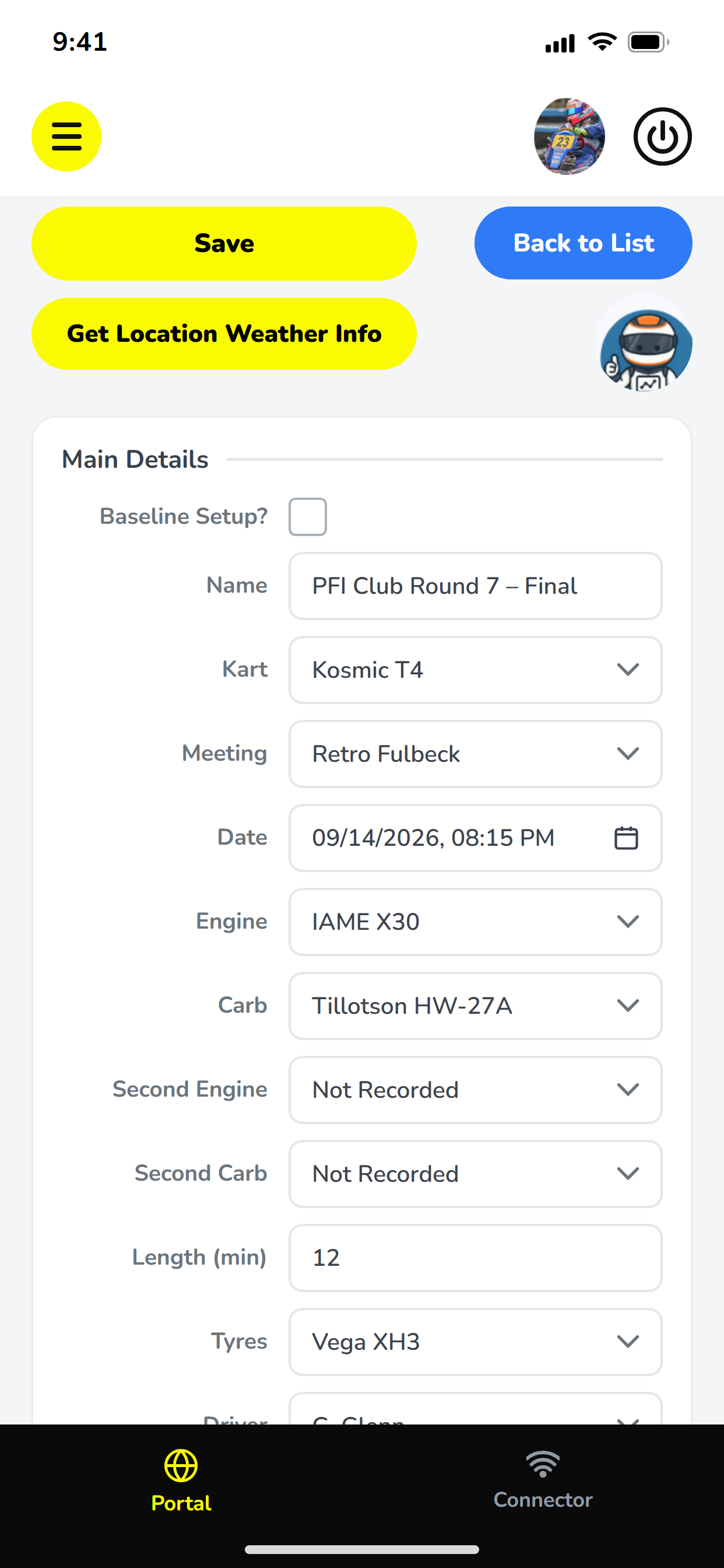
If you already keep a paper setup sheet, add three lines: jet or needle, air temperature, and the result you felt. After a season those lines will tell you more than any generic chart. The same logic applies to tyre pressures, which also shift with temperature.
What should you do next?
Get your engine builder’s baseline in writing, then log the conditions with every jetting change this weekend. Make single, small changes and lean towards rich when you are unsure. By the end of the season you will have your own table of conditions and settings, which is worth far more than a number copied from a forum.