A kart chain should have a small, consistent amount of slack: enough to move up and down by hand halfway between the sprockets, but never tight at any point as the axle turns. Quoted figures include roughly 1.5 to 2 cm on faster karts, or about 1/2 to 3/4 inch of play, so treat your manual as the final word. Check it before every session, and lube after every session.
How much slack should a kart chain have?
There is no single figure, because it depends on the kart, engine and chain type. KartClass suggests roughly 1.5 to 2 cm of slack on faster karts, with four-stroke and cadet karts able to run slightly slacker because they have less power. In a KartPulse thread, posters quote anywhere from 1/2 inch to about 1 inch of up and down movement on a standard chain.
Those numbers are anecdotal and overlap rather than agree, so use them as a starting window, not a rule. O-ring chains feel tighter when fitted and can’t run as slack as standard chains, according to KartClass, so don’t copy a figure from someone running a different type.
Why does too tight or too loose matter?
Too tight is the bigger risk. KartClass says an over-tightened chain drains engine power and can snap under strain, and one KartPulse poster says it should never go tight at any point in a full turn of the axle. Too loose lets the chain slap against the guard and can let it jump the sprocket.
That is why you measure at several points. A chain and sprocket set is rarely perfectly round, so slack can change as the axle turns.
How do you check chain tension?
Measure at the midpoint between the two sprockets, then turn the axle and measure again.
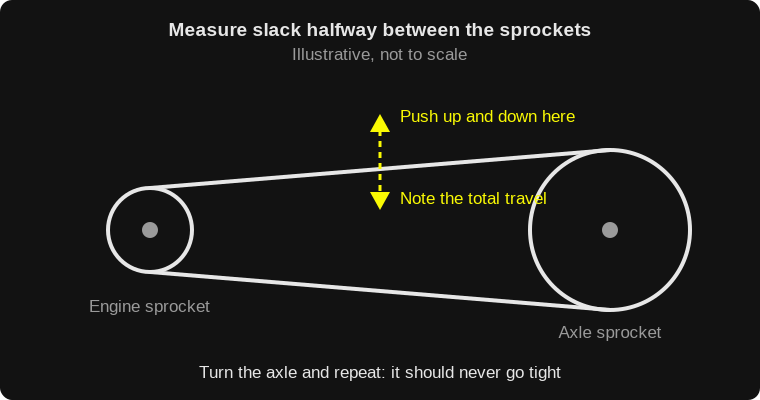
- Put the kart on stands so the rear wheels can turn freely, with the engine off and cool.
- Push the chain up and down halfway between the sprockets and estimate the total movement.
- Turn the axle a full rotation, stopping at three or four points, and repeat.
- If it goes tight anywhere, treat that as your limit and loosen it, not the loosest point.
To adjust, loosen the engine mounts, slide the engine, retighten and recheck. KartPulse posters disagree on mount torque: one tightens firmly by hand without crushing the tubes, another uses anti-seize, another uses Loctite. Nobody gave a number, so follow your kart’s manual.
How and when should you lube a kart chain?
Lube after each session, turning the wheel two or three rotations so it reaches the whole chain, as KartClass advises. Use a lubricant made for chains. Spray on the side links, give it a few minutes to soak in, then wipe the excess off the chain and away from tyres and brakes. Clean off the factory grease on a new chain first, because it is only there to protect it in storage.
Do it while the kart is already on stands and the chain is warm from running. It takes a minute, so it is easy to fit into the post-session routine.
When should you replace a chain?
Replace it when it can no longer be tensioned properly or shows signs of stretch. KartClass gives two practical tests. On the kart, pull the chain back at the rear sprocket with two fingers: a slight lift is acceptable, but if it nearly comes off the teeth, it is stretched. Off the kart, hold both ends and push the chain up and down. A new chain moves a little, a worn one moves a lot.
Don’t run a stretched chain on new sprockets. KartClass notes a worn chain wears the front and rear sprockets too, so replacing the chain early is cheaper than replacing everything later.
How do you keep chain checks from being forgotten?
Put it on a list and note what you found. A chain check is easy to skip when a session is running late, so make it a fixed item in your pre-session routine, and record the slack and lube date along with the sprocket sizes. Our race day checklist post covers building that list, and the gearing post explains why you need to recheck slack every time the sprockets change.
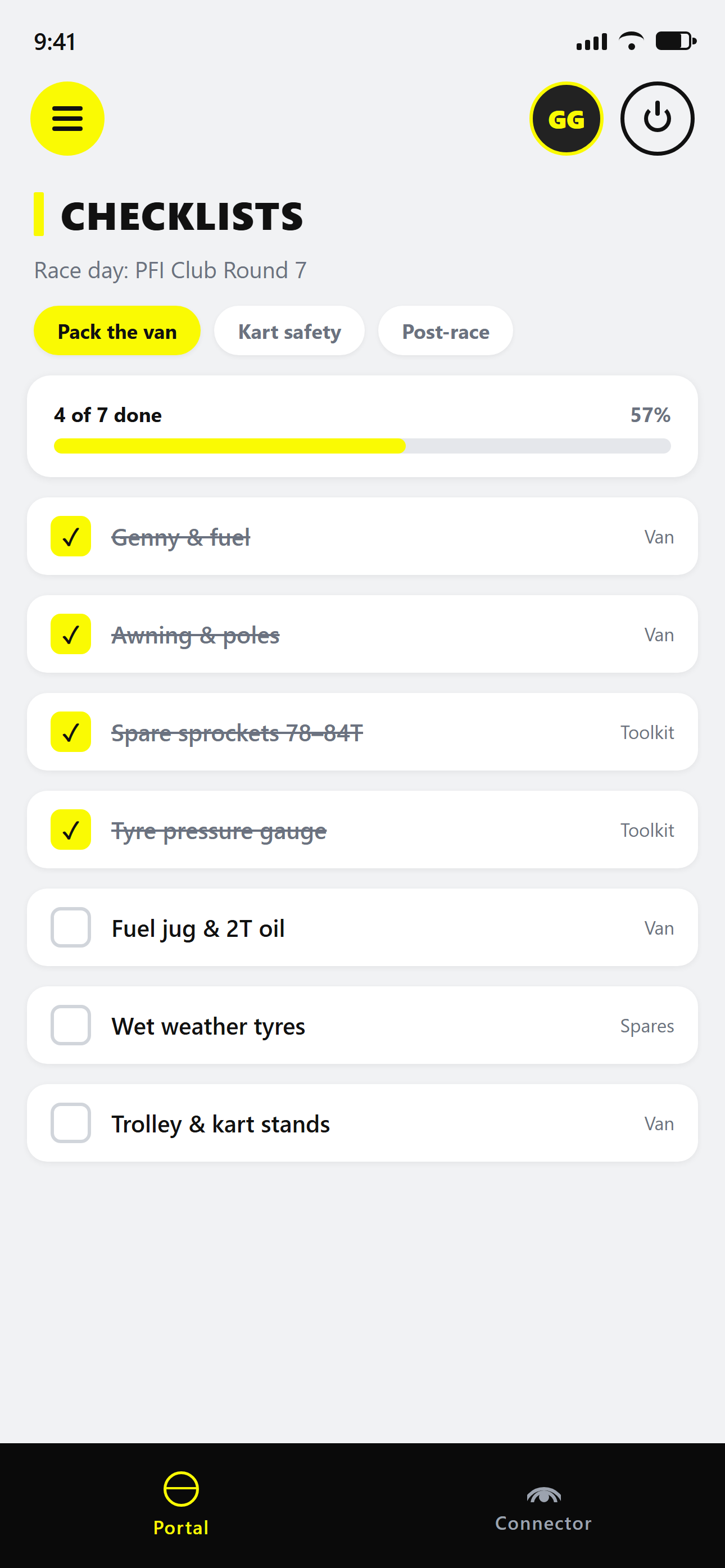
In KartSetups, you can keep a checklist for each race day, and logging the sprockets you ran with each session lets you look back at what changed when the chain feels different. If a workshop handles your maintenance, job cards can plan the work with due dates and assignees.
What should you do next?
Look up the slack figure for your kart, check it at several points around the axle before your next session, and lube it afterwards. Write down what you found, and next time you will know whether it changed.