Kart water temperature is the coolant reading on your dash, and the target depends on your engine, so take it from your engine builder rather than a forum. Many kart-industry guides put water-cooled two-strokes at around 50°C to the mid-50s, but what matters just as much is that the trace warms up quickly and then holds steady. A line that keeps climbing, or one that never reaches target, is telling you something about cooling, mixture or the sensor itself.
What water temperature should a kart run at?
Use your engine builder’s figure first, and treat published numbers as a sanity check. A PURPL guide to kart water temperature calls roughly 50°C the target for most water-cooled two-strokes and says power starts to fall away past the mid-fifties. It also reports that drivers quote different numbers depending on where the sensor sits. A Harris Race Radios sensor guide goes the other way and says there is no universal range for Rotax, Vortex, IAME or Briggs, and that the correct limits come from the engine maker for your exact engine and cooling set-up.
Those two views fit together. Roughly 50°C to the mid-50s is a common neighbourhood for water-cooled two-strokes, not a regulation. Where you measure changes the number, which is why the same engine can read differently on two karts.
Why does the shape of the trace matter more than the number?
A single reading says little, but a lap-by-lap trace shows whether the cooling system is coping. The chart below uses made-up data to show the three patterns worth recognising.
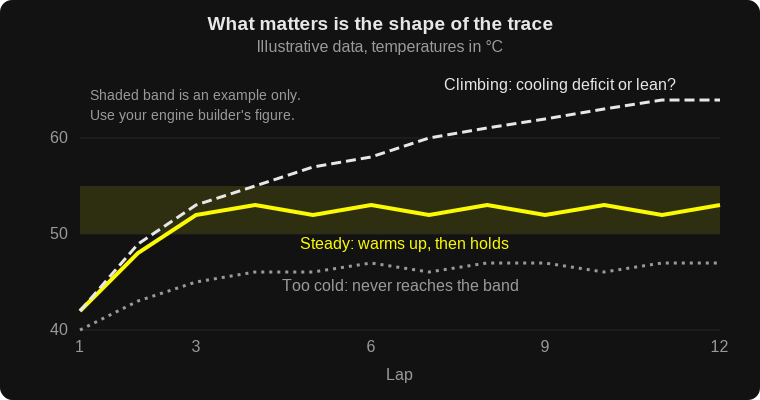
- Warms up, then holds. This is what you want. The curtain or radiator is doing its job and small wobbles are normal.
- Keeps climbing. The PURPL guide describes a line that never levels off as a cooling deficit. It is worth stopping to look before it becomes an engine problem.
- Never reaches the band. The engine is running too cold, usually in cold air or with too much radiator exposed.
What makes a kart run too hot?
The usual suspects are airflow, load and mixture. From the guides above, the common causes are a radiator curtain left too high or summer conditions with it open, following closely in someone’s slipstream, a long first stint on a green track, and a lean mixture. Lean running matters most because it is the one that can hurt the engine: on a two-stroke the fuel carries the lubrication. Our carburettor jetting post covers the signs and why you should go richer first when you are unsure.
If the temperature is climbing, the safe order is to cool the engine and then investigate. Stop safely, let it cool, and never open a hot pressurised cooling system. If it keeps happening, speak to your engine builder.
What makes a kart run too cold?
Cold air plus a generously sized radiator is the classic combination, along with a curtain too low or fully open in cold conditions. The PURPL article notes that running cold raises friction losses and can confuse carburation, which means a kart that is cold all day is probably slower and harder to jet properly.
Before you cover the radiator, check the reading is genuine. Harris advises verifying the channel and installation before changing radiator coverage, because an unexpectedly low value can be a configuration or connection problem rather than a cooling one.
How do you control kart water temperature?
The radiator curtain is the main tool, and you adjust it lap by lap. Raise it to warm the engine, lower it to cool it, and make the change in small steps. Beyond that:
- Partially mask the radiator in winter, for example with tape, where your class allows it.
- Fit a thermostatic valve where the rules permit it. Check your class regulations first, and don’t assume any cooling modification is legal.
- Address lean carburetion if the temperature creeps up under load.
- Avoid sitting in a slipstream through a long stint if you are trying to hold temperature.
None of these is a recipe. They are levers, and the right amount depends on the weather and your engine. Write down what you did and what the trace did next.
Is your water temperature sensor telling the truth?
Check it, because a bad sensor sends you chasing problems that do not exist. The PURPL guide lists three warning signs: stepped readings instead of a smooth curve, no response when you change the curtain, and a reading around 10°C different from a heat gun. It also recommends mounting the sensor where your engine manual says and keeping it there. If the value jumps or spikes, Harris points to the connection, wiring interference, trapped air or the sensor itself before assuming overheating.
One more caution from Harris: coolant temperature alone cannot show whether an engine is rich or lean. Treat it as one clue next to plug colour, piston condition and how the kart pulls.
How do you use water temperature in your data?
Compare the same channel session to session, not one lap in isolation. Import your logger file and look at the water temperature trace beside RPM and speed, so you can see whether a climb coincides with a long full-throttle section, a slipstream or a lean-feeling straight. KartSetups imports AIM, Alfano and Starlane logger data and shows RPM, speed, exhaust and water temperatures on one set of graphs, as described on the home page.
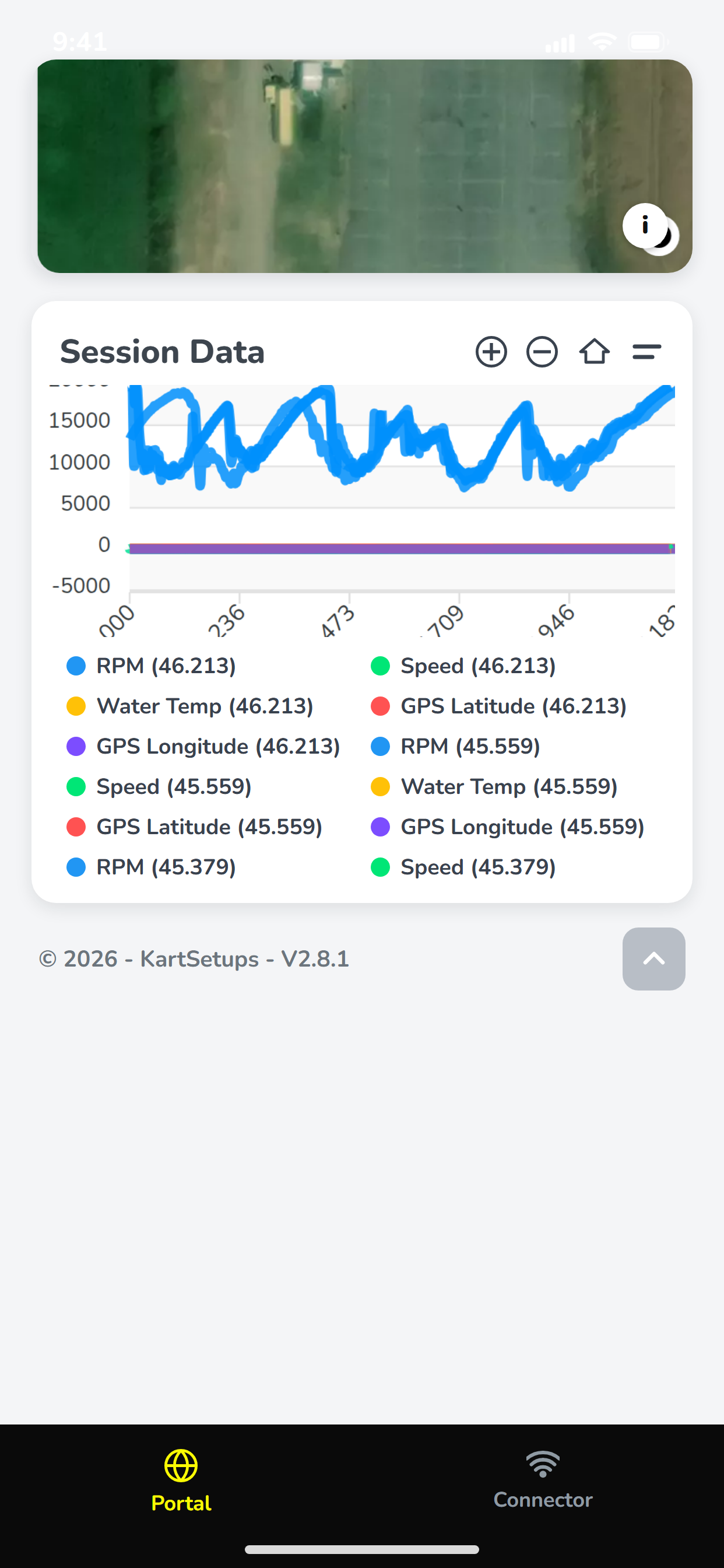
The context you log matters as much as the trace. Note the air and track temperature, the jetting, the curtain position and what the kart felt like, ideally in the same session record. Our setup sheet guide shows what to write down, and the kart data post covers which channels are worth looking at first.
What should you do before your next session?
Find out your builder’s target and warning figures, confirm where the sensor is meant to sit, and check it against a heat gun. Then log a stint with the curtain position noted, and compare the trace next time conditions are similar. After a few meetings you will know what your engine does on a cold morning and a warm afternoon, which is far more useful than a number copied from a forum.