Kart ballast placement is about where you put the weight you must carry, not only how much. Most karters mount it low, then adjust left, right, front or rear to shift the corner weights, and the only reliable way to know if a move helped is to change one thing at a time and compare it with a logged baseline. Your class rules decide where ballast may legally go, so check them before you drill anything.
Why does ballast position matter at all?
Because mass is not just a number on the scales: where it sits changes how much load each tyre carries. If a driver is under the class minimum weight, ballast brings the kart (with driver) up to it, and the position you choose changes the corner weights as well as the total. A kart is a very light chassis with a driver who is a large part of the total mass, so a couple of kilos moved a short distance is a real change.
This also means a driver swap, a new seat or a different fuel load all move your balance before you touch a spanner. Our seat position post covers how seat changes shift weight, and the front end setup guide explains how the chassis responds to load at the front.
How do you measure corner weights and cross weight?
Weigh the kart on four scales with the driver in race kit, then work out the totals. A write-up on Vroomkart describes a professional version of this: weigh the kart alone and with the driver, and also with one axle raised, then put the numbers into a spreadsheet that calculates total weight, cross weight and the differences. Fuel also matters, because the same article notes it can change total weight by up to a kilo depending on conditions.
Cross weight is the sum of the left front and right rear, divided by the total. Here is a worked example with made-up numbers:
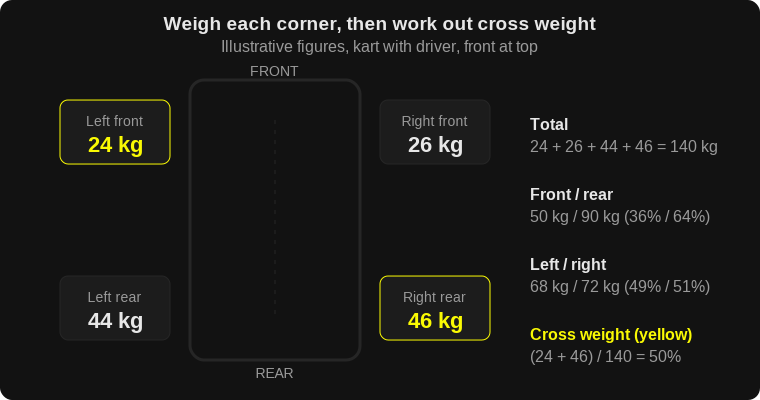
I’m not going to give you a target percentage, because the right balance depends on the chassis, the driver and the track, and class rules can affect it. What the numbers give you is a before and after: if you move a kilo and the cross weight shifts by a measurable amount, you know the change was real.
Where do karters usually mount ballast?
Low is the common thread, and left-side placement comes up often, but there is no single answer. In a KartPulse forum thread on adding ballast, one driver suggests keeping weight as low as possible on the left and sees no need for it on the right because the engine already sits there. Another places a lot of it higher up, saying he does that for weight transfer, and notes that a taller driver can mount it more or less anywhere. Others spread the total across several small pieces rather than one block.
Treat that as a spread of opinions, not instructions. The patterns worth keeping in mind are:
- Low keeps the centre of gravity down, so it is the usual default.
- Forward or rearward shifts the front/rear split, which changes how the kart loads the front tyres on turn-in and the rear on exit.
- Left or right shifts the side split and cross weight. The engine and driver already make the kart asymmetric, so you are correcting or exaggerating that.
- Several small pieces are easier to tweak by a small amount than one large block.
Vroomkart’s method works backwards from the measurements: if the spreadsheet says weight needs to move to the front left, the ballast goes in the far front left corner of the seat, then you re-weigh. Check the result, because moving one piece changes more than one number.
What do your class rules allow?
Check them before you fit anything, because ballast is commonly regulated. Rules can cover how ballast is secured, where it is mounted and whether it has to be bolted through or fixed with approved brackets. One forum poster mentions a league that does not allow ballast on the skid plate, which is exactly the kind of local rule that catches people out. I’m not going to state any class’s rule here without a source: read your own regulations, and if in doubt ask the scrutineer at signing-on.
How do you test a ballast change properly?
Change one piece in one direction, keep everything else the same, and compare it with a baseline. The sequence is: weigh, move one piece, run the same stint on the same tyres, then compare lap times and the driver’s comments.
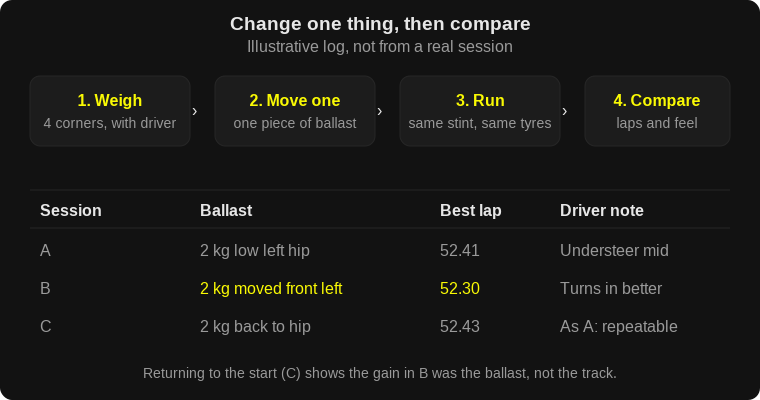
A few rules keep the result honest:
- Move a small amount first. A kilo is easier to read than five.
- Keep tyre age and pressures consistent, or you will be measuring the tyres. Our tyre pressures post goes into this.
- Return to the baseline at the end to check the change was real and not the track rubbering in.
- Record the driver’s words next to the lap time. “Turns in better” or “pushes mid-corner” explains the number.
How do you track ballast changes over a season?
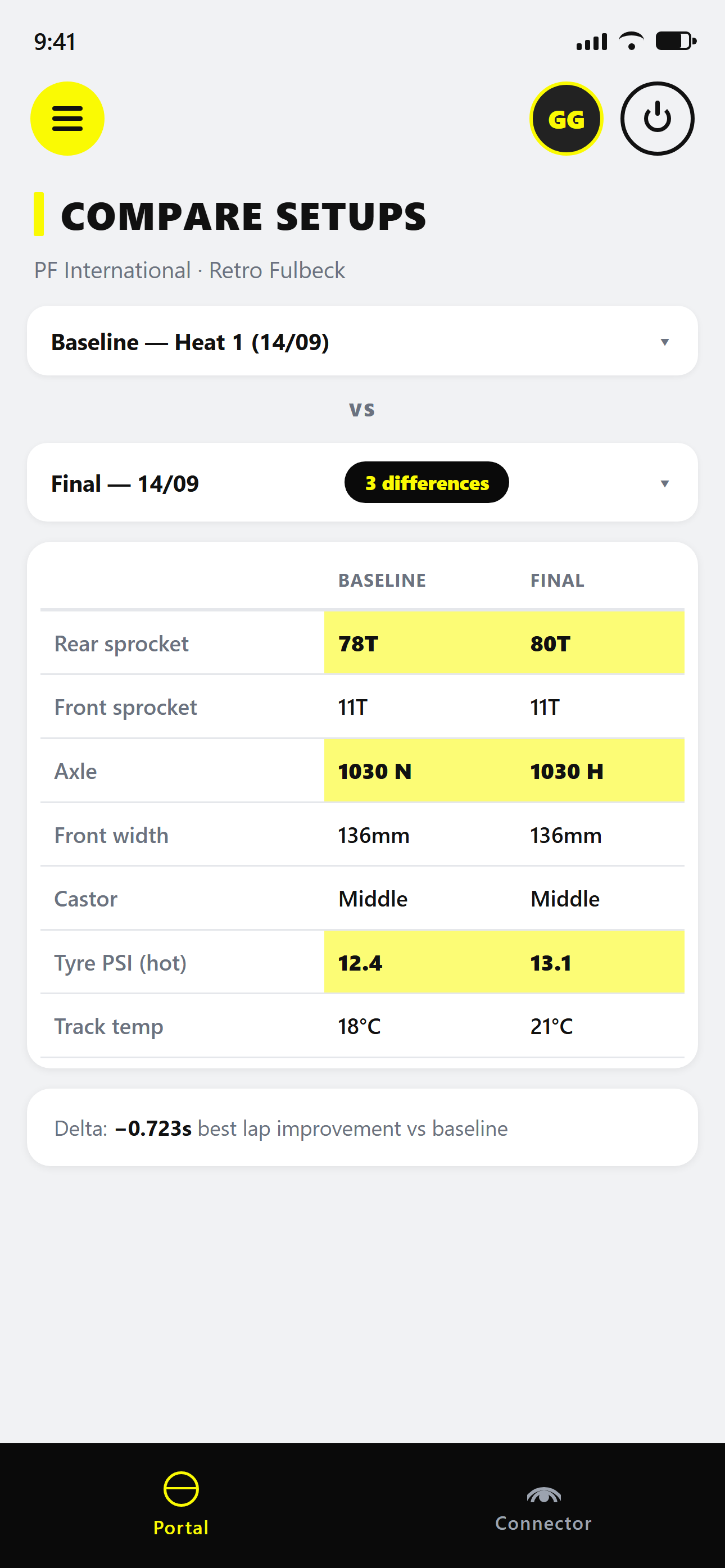
Write every change down in the same place as the lap times, or you will not remember which of three small moves made the difference. In KartSetups you can store the setup for each session, use Compare Setups to put a baseline next to a later session with the differences highlighted, and see the lap time delta alongside it. The sessions list also shows which setup changes were made between consecutive sessions next to the lap time delta, as listed in the release notes.
If you already use a setup sheet, add a line for ballast mass and position, plus corner weights if you have scales. A season of that is far more useful than one very precise weigh-in.