Kart brakes need three habits: bed in new pads and discs before you rely on them, bleed the system when the pedal feels inconsistent or before a race weekend, and check pads and disc before every race day. Pads wear faster than most people expect and lose effectiveness before they look finished, so a one-minute look at the pads is cheap insurance.
How do you bed in new kart brake pads?
Bedding transfers an even layer of pad material onto the disc, and it needs doing before the brakes see hard use. Always follow the procedure from your brake or pad manufacturer, because compounds differ and I have not found a single figure that applies to all of them. The principle that recurs across sources is to build heat gradually and not to force the pads to stop the kart during bedding.
A few practical points:
- Do it somewhere safe, with the pads and disc clean and free of fluid or grease. Wilwood warns that brake fluid contamination on pads or rotors ruins them.
- Expect light squealing in the first few stops. Comet Kart Sales says squeal that fades after a few stops is normal bedding.
- If you later find the surface shiny and the brakes lacking bite, Kart Parts Depot describes the fix as sanding the pad and disc, bleeding the brake and bedding again.
When should you bleed kart brakes?
Bleed when the pedal feels poor or inconsistent, not just on a calendar. Kart360 lists these triggers: a poor or inconsistent pedal, the kart having been stored vertically, an upcoming race weekend, or dirty fluid after extremely hot conditions. Air can also get in during a pad change, when the caliper pistons are pushed back.
The Kart360 walkthrough, in outline:
- Fit a bleeder to the master cylinder fill port and open its valve.
- Fit a wrench and a recovery hose to the caliper bleed screw, then loosen it.
- Let fluid flow until the air bubbles are gone, then tighten the screw. Repeat for a second screw if there is one.
- Close the bleeder, refit the fill plug (keep its o-ring in good condition, as it provides the seal) and press the pedal. It should feel solid.
Comet Kart Sales puts a bleed at roughly five to ten minutes, so there is little excuse to leave it. Use the fluid your manufacturer specifies, and keep it off the pads and disc.
What should you check on pads and disc?
Look at both pads, the disc and the caliper action before each race day. The symptoms below map to the first thing worth checking.
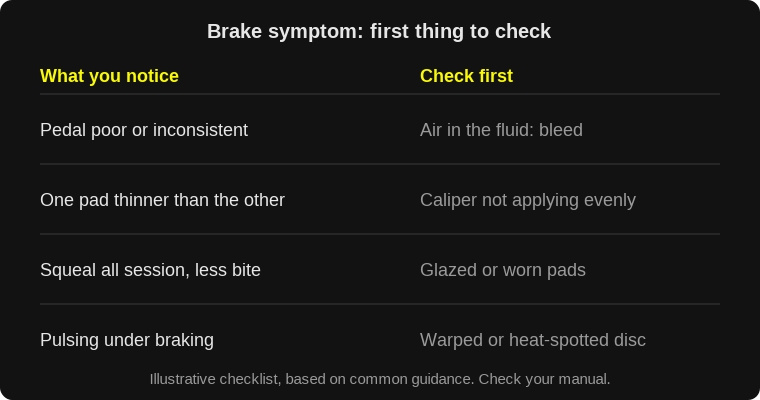
According to Comet Kart Sales:
- Pads: replace them when the friction material looks thin, wear is uneven, the surface is glazed or the feel has changed. Replace both as a pair if one is noticeably thinner.
- Dragging caliper: a caliper that does not fully release adds heat, wears pads and disc quickly and makes the kart feel slower. Uneven wear between the two pads suggests a caliper problem.
- Disc: warping is the most common failure and shows as pulsing under braking. Blue or purple heat spots, or scoring deep enough to catch a fingernail, are reasons to replace it.
The article gives no minimum pad or disc thickness, and I could not find a universal one. Use the minimum in your brake manufacturer’s documentation.
Why log brake work with your setup?
Brakes change how the kart feels, and a feel change you blame on the chassis may be a tired pad. If you record the date of the last bleed, pad change and disc swap alongside each session, a sudden loss of bite or an inconsistent pedal can be matched to its cause instead of guessed at. It also stops you chasing a tyre pressure or front end change when the real problem is the brake.
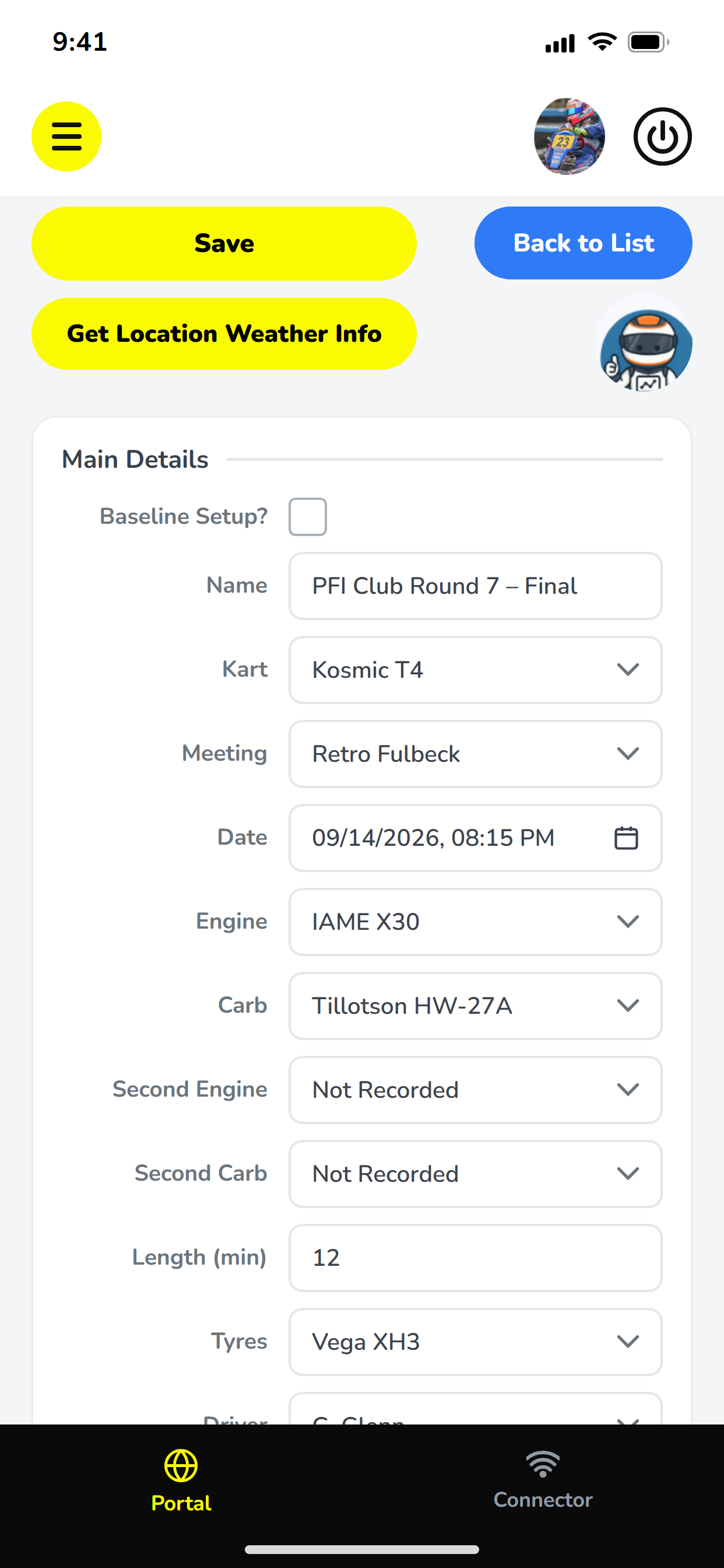
In KartSetups, each session is stored against the kart, engine and tyres it ran with, and a race day checklist can hold a repeatable “check pads and disc” item. For the wider habit of logging changes one at a time, see our setup sheet guide and the chain tension post, which covers a similar before-every-session routine.
What should you do next?
Before your next session, look at both pads and the disc, press the pedal and check it feels solid, and note the result. If the pedal is soft, bleed it. If a pad is uneven, look at the caliper before you buy new pads. Then write down what you found, so next time you know what changed.