To scrub in new kart tyres, heat them gradually: a slow out lap, a few laps with progressively more pace, then a proper cool-down in the pits. Exact lap counts vary by compound and track, and some soft tyres are better left alone, so the useful habit is to log what you do to each set and compare how it comes on.
Why do new kart tyres need bringing in at all?
A new tyre has a fresh surface that has not been through a heat cycle. Flow Racers describes the first shiny layer as a protective coating that is gone within a couple of laps. Tyre makers in other forms of racing warn that a hard first heat can spike the temperature and affect the tyre for its whole life, as Toyo’s guidance on semi-slicks puts it. That advice is for road-car semi-slicks, not karts, but the principle is why karters go easy at first.
I am not going to give you a manufacturer procedure, because I could not find an authoritative lap count for the common kart tyres, and it differs by brand and class. What follows is the common ground between the kart sources, framed as a starting point.
What is a sensible first outing on a new set?
Start slowly and build up. Kart Class advises building speed gradually on the warm-up lap, braking gently at first because cold tyres lock easily, and weaving only enough to scrub the surface, since too much weaving can unsettle a cold kart.
In a KartPulse forum thread on breaking in tyres, one driver relays advice from a Dunlop engineer to take the first out lap very slowly so the heat goes in gradually, while another says soft tyres only need about half a lap at around 75 per cent before going hard. They disagree, which is useful to know: advice depends on the tyre.
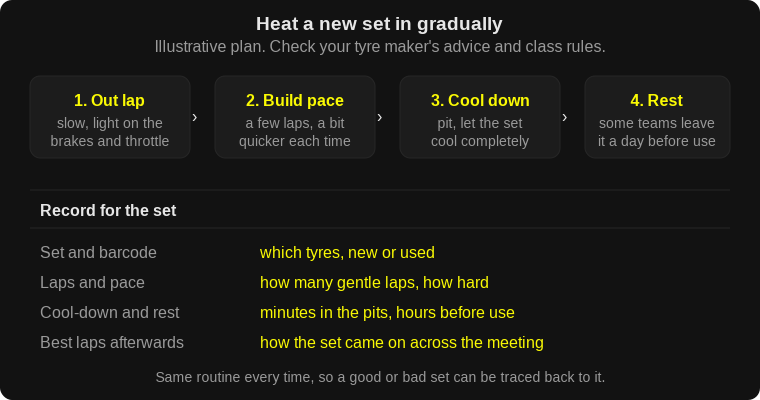
A reasonable shape for a first stint, to be adjusted for your compound:
- Out lap: slow, smooth, light on the brakes and throttle.
- A few laps: each a little quicker than the last, without sliding the kart. Watch your lap times, and stop building once they stop dropping.
- Back in the pits: let the set cool completely before refitting or racing on it.
Does every compound need this?
No, and this is where most of the disagreement lies. KartPulse forum discussion suggests soft tyres usually perform best in their first laps, so there is little point scrubbing them first, while harder tyres may need the outer layer worn off before they give their best. Some drivers also say a particular tyre should be run hard from new. Check with experienced drivers in your class and with your tyre supplier before you assume one routine fits all.
Also check your rules. Some series regulate tyre marking, allocation and any preparation. Flow Racers also notes that some tyre prep methods are not allowed in every series, so read your regulations before you copy a routine from a video.
Should the tyres rest before race day?
Some do, some don’t. In the same KartPulse thread, one driver lets the set rest 24 hours in a cool, dark place before racing and keeps two sets so one is always ready, and reports two to four race weekends from a set. Another says wrapping the tyres makes little difference. Car-tyre guidance makes a similar point about leaving tyres to settle after a first gentle heat cycle, but that is not a karting source, so treat a rest period as an experiment on your own tyres, not a fact about karts.
How do you know whether your routine works?
Compare it. One set scrubbed gently and another run hard from new is a test, but only if everything else is the same: track, pressures, driver, time of day. Our tyre pressures post covers logging hot and cold pressures, and the same discipline applies here. The wider method of changing one thing and comparing is in karting data analysis.
For each set, record:
- Which set it is, and whether it is new, scrubbed or used
- What you did on the first laps and for how long
- Cool-down time and any rest before use
- The best lap on the set across the meeting, and the point where it dropped off
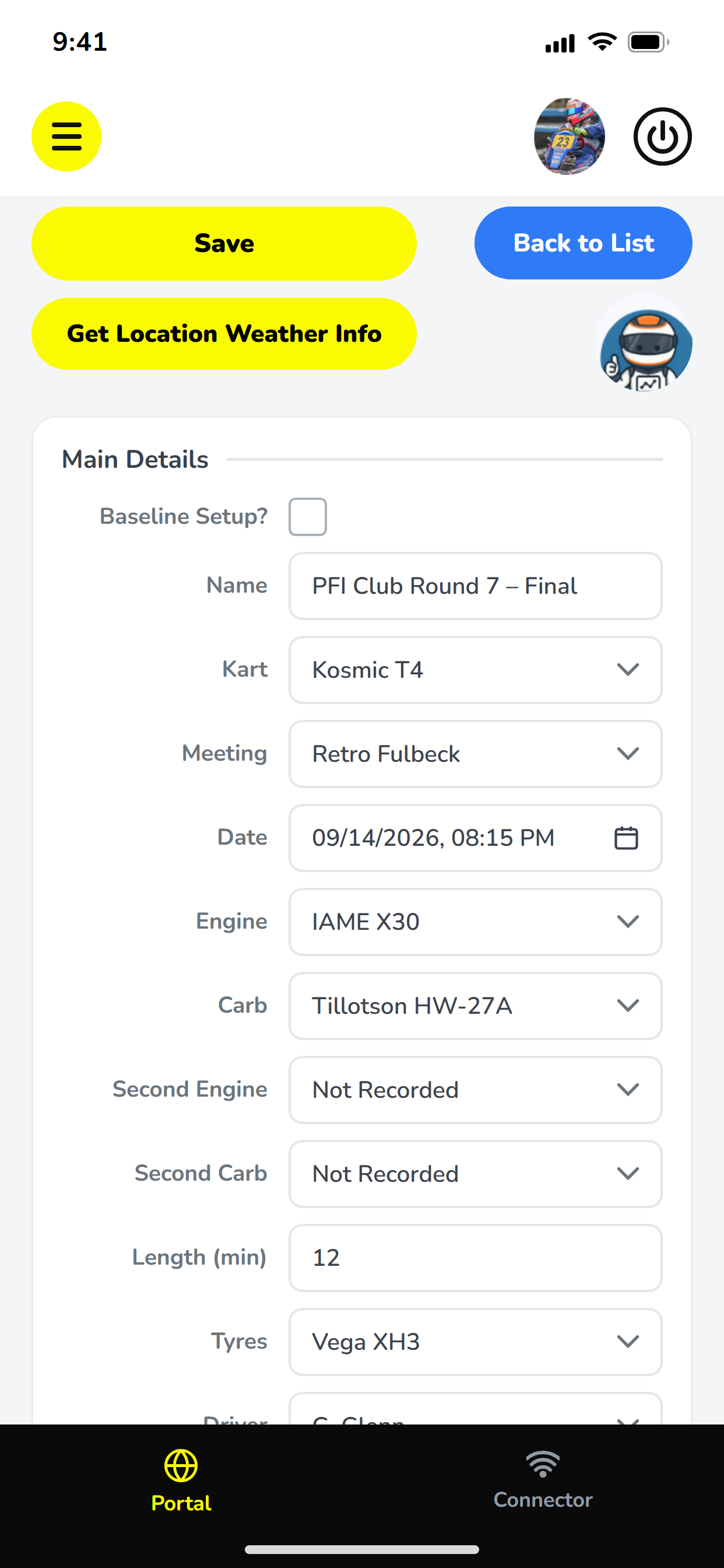
In KartSetups you pick the tyre set on the session setup, and Tyres shows the laps used next to each set, so you can see how many laps a set had when its best times came. You can also upload photos of tyre barcodes from any device. These are listed in the release notes. Over a season that shows you whether the routine you chose gives you more good laps per set.
What mistakes do people make with new tyres?
- Going hard on the first lap. Cold tyres give little grip and lock easily, and a hard first heat can shorten the life of the set.
- Scrubbing a compound that doesn’t want it. Soft tyres can lose their best laps while you are warming them up.
- Changing the routine every time. If you vary the procedure, pressures and track together, you cannot tell which one mattered.
- Not logging the set. Without a record, a good set is a mystery you cannot repeat.
Want to keep every set’s laps, pressures and notes in one place? See the features and pricing and try KartSetups free.